24 Mar 1942: William McGarry was a pilot assigned to the Flying Tigers (offsite link), more properly, the American Volunteer Group (AVG: offsite link). He flew in the 1st Squadron (nicknamed the “Adam and Eves”):1

On this date, having earlier flown out of Kunming, Yunnan2 (Google Maps link), to Loiwing (Leiyun), Yunnan3 (Google Maps link), and then on to an RAF airstrip in Namsang, Burma4 (Google Maps link)5 (Google Maps link) . . .
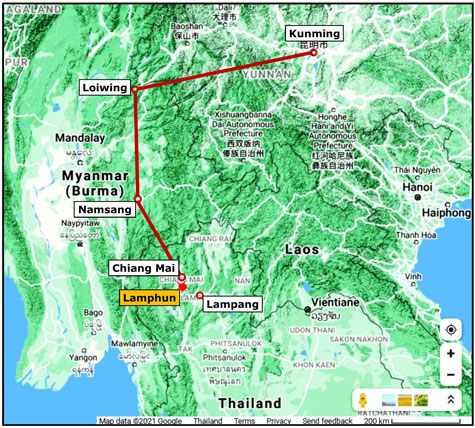
. . . he was one of ten Flying Tigers to attack Japanese-held airfields in northwest Thailand. His group of six P-40s was to strafe Chiang Mai Airport (Google Maps link), while the other group of four P-40s, led by Jack Newkirk, was to attack Lampang Airfield (Google Maps link). Flying as “top cover”, McGarry’s plane was hit by anti-aircraft fire from the airport. He successfully nursed his plane about 125 km northwest into Mae Hong Son Province where he had to finally bail out.6 After 28 days7 on the run, he was captured by Thai police. Following an inconclusive interrogation by Col Tateo Kato, commander of the 64th Sentai located in Chiang Mai, McGarry was sent to a Bangkok jail where he languished for three years.8 On 14 April 1945, he was smuggled out of Thailand at the specific request of Gen Claire Chennault, who had been his commander in the AVG in 1942.9
Crash site:
Discovery of wreckage that was most probably McGarry’s P-40 was first recorded in a telegram from Mae Hong Son dated 10 April 1944 which located the crash site in Tambon Pang Mapha, about 23 km ENE of the actual site as later determined;10 the detail in the report strongly implied that the wreckage was indeed that of McGarry’s P-40, but it was wrongly located. No record has surfaced to date of any action taken as a result of the message. Nor has any aircraft wreckage ever been found in Pang Mapha.
However, in 1991, “tribal hunters” found aircraft wreckage north of Mae Hong Son town:11
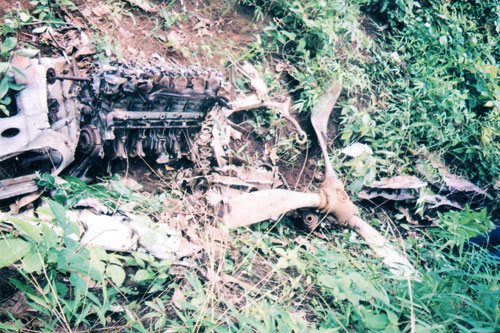
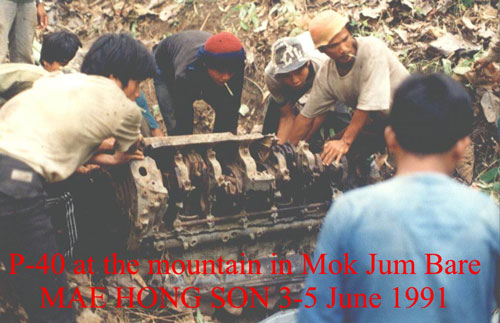
Tango Squadron Museum Chiang Mai investigated and confirmed that the wreckage was that of McGarry’s P-40. That it took almost 50 years to be rediscovered suggests the remoteness of the site. The wreckage was retrieved in June 1991. Note the location superimposed on the image, “Mok Jum Bare”, which would later evolve to “Mok Cham Pae”:12
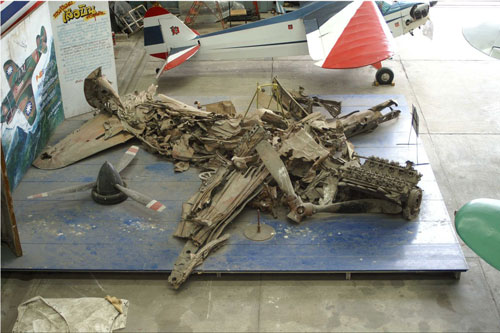
And it is now on display at a Tango hangar in Chiang Mai Airport:13
In 1998, Muang Mae Hong Son sought assistance in investigating an aircraft crash site vaguely located somewhere in or near Tambon Huai Pha.14
An independent research group around 1999 visited the crash site and claimed to have found wreckage.15
The wide range of reported locations over time for McGarry’s P-40 wreckage shows the problem in trying to identify the actual crash site:16
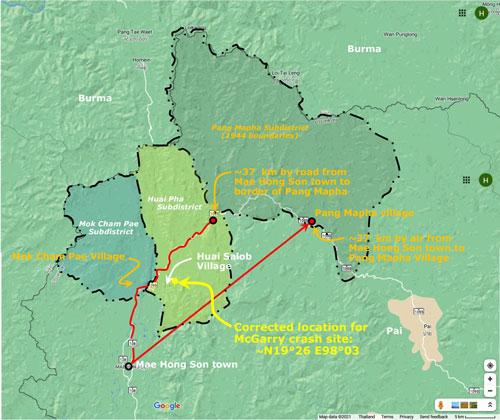
In the map above, previous locations, “Pang Mapha” reported in 1944 and “Mok Cham Pae” recorded in 1991, are shown in tan. Note the ambiguity for 37 km from Mae Hong Son to Pang Mapha: it could be interpreted as road or air distance, with road distance ending at the boundary to Pang Mapha District while air distance ends at Pang Mapha village. Similarly, Mok Cham Pae, village or subdistrict? The correct location of the crash site is shown in red.
Numerous interviews conducted in the area concluded that the report simply recycled information about the McGarry site discovered in 1991.17
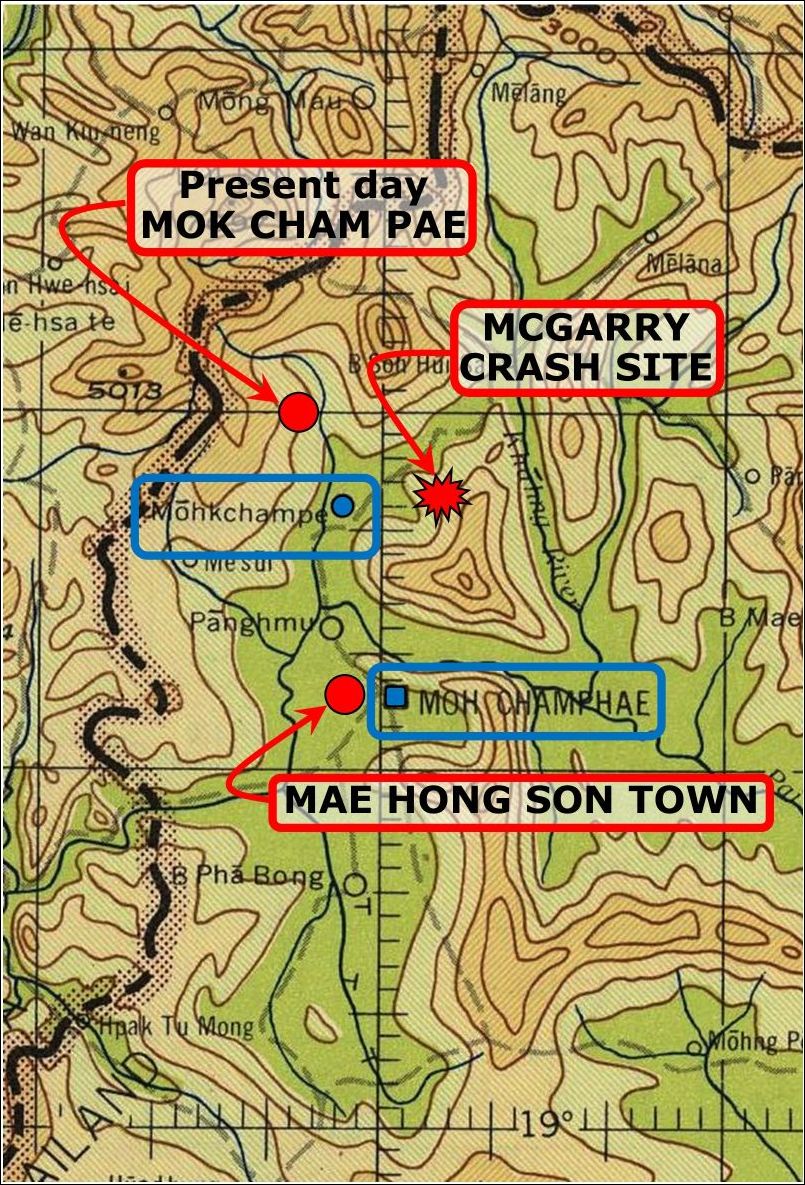
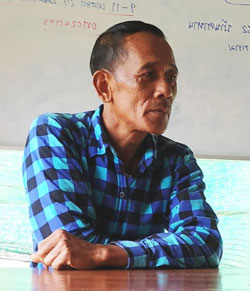 The location of the crash site for McGarry’s P-40 was originally and wrongly recorded by Tango as Mok Cham Pae (Google Map link).18 This was recently corrected in an interview with one of the local participants in the 1991 salvage work, a Mr Paeng Suampan (pictured left).19 He said the McGarry crash site20 (Google Maps link) was about 3 km east of Huai Salob Village in Tambon Huai Pha. Some wreckage had been said to have been left with the sub-district for possible use in a future museum:21 but neither Mr Paeng nor the deputy headman for Huai Salob, Mr Sutisak Somboon, was aware of such. Asked why the location had been wrongly recorded, the two suggested that in 1991 admin boundaries had not been as well defined nor as relevant as they are now. There is also the possibility that Tango was intentional in wrongly locating the site so as to discourage souvenir hunters. Another possibility is that an older map was referenced, at least one of which, while not even mentioning Mae Hong Son, names two sites ambiguously in the area as “Mōhkchampe” and “Moh Champhae”. Those two are circled in blue in the map below, while present day features, including the actual crash site, are circled in red:22
Afterword:
Following the war, McGarry earned a law degree and thereafter practiced law with the US military to his retirement. He died on 13 April 1990 of cancer in Loma Linda, California.23
The wreckage of his P-40 was discovered about a year after his death.
References (listed chronologically by publication date):
• Ford, 1991:24
The plan called for Eddie Rector and Mac McGarry to stay high as top cover. [Charlie] Bond led the other three pilots onto the field . . . .
The top cover had taken the worst of the flak, and McGarry’s engine was spluttering. “I circled back & tried to rendezvous on his wing,” Rector wrote in his combat report, “but his speed was too slow & I overshot. . . . I saw smoke coming from his engine intermittently & he seemed to be losing altitude. After continuing in this condition for five or ten minutes & losing more altitude, McGarry turned left over a canyon, turned the plane over & fell out. His ‘chute opened instantly & he landed about 200 yards from his plane.” McGarry waved to his buddies, who dropped a candy bar and a map showing his location and the time: thirty miles south of the Salween River at 7:41 am, March 24, 1942.25
. . . Thai policemen captured him and took him to Chiang Mai, where Colonel Kato questioned him. . . . He then handed the prisoner back to the Thai police. Instead of suffering the horrors of a Japanese prison compound, therefore, McGarry entered upon a lonely but tolerable existence in a Bangkok jail.
• Shores, 1993:26
McGarry’s 1st Squadron aircraft was . . . hit and was seen to trail smoke; he baled out 55 miles from the border and remained at large for 28 days, before being captured by Thai police. The AVG had lost two of its leading pilots [the other being Jack Newkirk]. However, the attack had been about as successful as estimated, although their victims had not been bombers, but Ki 43s of the 64th Sentai. Three of these went up in flames and at least ten others were damaged beyond repair.
• Umemoto, 2002:27
Entry for Mac McGarry (Umemoto, v 1, p 461) Item Japanese English translation Date 昭和17年03月24日 24 March 1942 Unit 2Sqn/AVG 2Sqn/AVG Casualty P-40B Curtiss P-40 Warhawk Pilot マック•マクギヤリー Mac McGarry Location チェンマイ飛行場 Chiang Mai Airport Shooter 対空砲火 Anti-aircraft fire Details 落下傘降下•捕虜 Parachuted; POW Umemoto comment (translated):28
◎ “Immortal Jack”, 64th Sentai humiliation, Chenmai air raid
On March 24, P-40s of the US AVG were dispatched from Kunming to strafe Japanese heavy bombers at Lampang Airfield in Thailand. . . . “Mac” McGarry’s aircraft was also damaged, and, on his way home, he parachuted out to be captured by a Thai police officer and handed over to the Japanese army. Because there was no Japanese who could directly interpret his English, a Thai interrogated him in English, which was then translated into Japanese by a second Thai interpreter. The interrogation centered on the AVG presence in Rangoon.The interrogation centered on AVG pilots painting Japanese flags on the fuselages of their aircraft to tally shootdowns. Since they were very active, many flags had been put on P-40s. However, this was said to be inaccurate and the result of wishful thinking. I am sorry that Lt Col Tateo Kato, who was familiar with French, but not English, had to listen to the results of this cross-examination later in Bangkok, and became indignant at the mistakes made in the interrogation. Lt Col Hinoki recalls this situation in his book.
| First published on Internet | ||
| Kunming-Chiang Mai map added | ||
| Add copy para, change title, footer | ||
| Converted to WordPress by Ally Taylor | ||
| Updated, author major errors & typos corrected | ||
| Maps corrected & supplemented | ||
Last Updated on 2 September 2026
- Photo from Tango Squadron Air Museum (offsite link) by “Starling” who does not source the photo.[↩]
- N24°59.50 E102°44.60[↩]
- N23°53.93 E97°37.40[↩]
- N20°53.33 E97°44.17[↩]
- Map extracted from Google Maps; annotations entered with Microsoft Publisher by author.[↩]
- bail is standard in the US; bale standard in the UK (Prof Paul Brians[↩]
- Bob Bergin records'”three weeks” [per TimL (Tim Landers) in forum on flyingtigersavg.com (forum blog not now accessible), posted 01-29-2004 01:16PM. [my ref: 02313 1095 192 McGarry crash site:flyingtigersavg.txt]]. Whichever duration, avgbob in same forum, 01-18-2006 11:28AM, records “He said he ate everything and drank the water. He felt that he would get sick, but he would have immunity after that. I guess it worked.”[↩]
- Ford, Dan, Flying Tigers (Washington: Smithsonian, 1991, 2007), pp 244-245. Note that Umemoto records Kato as only reviewing the results of the interrogation later in Bangkok (see References “Umemoto comment” below).[↩]
- Bob Bergin, “The Exfiltration of Mac McGarry” (offsite link), posted June 2016. One oblique explanation of McGarry’s disappearance from “jail” appeared in a post-liberation interrogation of Ronald W Derrick, 1318896, who had been downed in BZ992 on 05 October 1944 and apparently imprisoned in the same facility as McGarry:
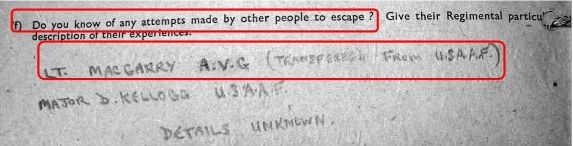
(my ref: \02500 Tango\_Crash sites N TH for Tango\DETAIL SHEETS\A441006 _events\Emails-Matt\20220307 Matt Poole\WeTransfer\derrick3,dk pt.jpg) [↩]
- Sakpinit Promthep email of 23:22 22 Nov 19, att “19440410-1 front.jpg”[↩]
- Ref needed for “tribal hunters”. Photo: Sakpinit Promthep email of 23:22 22 Nov 19, att “P-40 19420324 McGarry.jpg”[↩]
- Line message from RTAF Mjr Veerachad to Wiyada Kantarod 22 Feb 2020, att 1582442349565.jpg.[↩]
- Thai Aviation: Flying Tigers Curtis P-40 Curtis P-40 crash remains. (offsite link) [“Curtis” should be “Curtiss”][↩]
- Sakpinit Promthep email of 01:19 01 Sep 20, att “19980519-01.jpg” et al, Mae Hong Son City Hall to [Tango], Subject: Assistance requested to inspect aircraft wreckage (translation) [↩]
- Sakpinit Promthep email of 01:19 01 Sep 20, att “19980519-01.jpg”, Mae Hong Son City Hall to [Tango], Subject: Assistance requested to inspect aircraft wreckage (translation), cover letter. The research group mentioned was probably หัางหุ้นส่วนจํากัดเฌอกรีน, Green Tree, LLP, Ltd, which produced รายงาน การ สําร จอขุดค้น ตาม โครงการ คึกษาเชิงอนรักษ์แหล่งฝังศพทหารญี่บุน สมัย สงครามโลกครั้งที่2 จังหวัดแม่ฮ่องสอน, Report on Archaeological Research For the Japanese Soldiers Burial Project World War II Era – Mae Hong Son Province (Chiang Mai: Archaeology & National Museum Office 6, 1999) [↩]
- Google Map of area annotated with Microsoft Publisher by author.[↩]
- Various interviews conducted by Wiyada Kantarod and Hak Hakanson between 08 Feb 2020 and 05 Apr 2021.[↩]
- Mok Cham Pae means literally, “flower with name “Cham Pae”; see photo, 1582442349565.jpg, above, with superimposed title “Mok Jum Bare”. This is a transliteration of the Thai, หมอกจำแป่. Mok Jum Bare is rendered by RTSD Map 4547 I “Chungwat Mae Hong Son” (1976 data), as Mok Cham Pae or Mok Champae. and is therefore the official version of the place name. Regardless, Tango’s transliteration provides the more accurate Thai pronunciation.[↩]
- Interviewed by Wiyada Kantarod and Hak Hakanson on 06 Apr 2021 in Huai Salob (N19°26.583 E98°1.073) (Google Maps link). Photo, by author, aIMG_20210406_134543.jpg extract.[↩]
- N19°26.60 E98°02.81[↩]
- Discussed at a meeting of “Founding Committee of the Friends of Tango Air Museum Club” on 02 Jul 2020.[↩]
- Map source: McMaster U Digital Archive, Hamilton, Ontario, Canada, GULF OF MARTABAN (677), Aeronautical information JANUARY 1945, by AAF Aeronautical Chart Service; annotated by author using Microsoft Publisher; my ref: \bPROJECT\_MAPS\THAILAND Maps\COLLECTN McMASTER\677-macrepo_76844.jpg677-macrepo_76844.jpg[↩]
- Arcado Nickii Wantakan, Finding Freedom (offsite link).
This site quotes an intriguing insight into the origin of the term “Flying Tigers”, quite possibly accurate, judging from its source:
“Learning that the superstitious Japanese feared sharks, the ingenious Yanks painted the snout’s of their P-40s to represent grinning heads of ‘tiger sharks.’ The A.V.G. pilots called themselves ‘Tiger Sharks’ but it was not long before the admiring Chinese troops changed it to ‘Flying Tigers’ the tiger being regarded as a minor deity in some sections of China.”
– Source: WAR HEROES, No. 2| October-December 1942[↩] - Ford, ibid, pp 245-247.[↩]
- “I have a personal feeling for “Black Max” McGarry, as he lived here in Desert Hot Springs. I helped him on his needs until he died. He told me some interesting stories. As for his bailout over Chiang Mai, he never saw any note, that was supposed to have been dropped to him . . . .” — tigergroupie in forum on flyingtigersavg.com (forum blog not now accessible) posted 09-10-2002 04:24PM. [my ref: 02313 1095 192 McGarry crash site:flyingtigersavg.txt][↩]
- Shores, Christopher and Brian Cull with Yasuho Izawa, Bloody Shambles, Vol Two (London: Grub Street, 1993), pp 356-357.[↩]
- 梅本弘 [Umemoto, Hiroshi], ビルマ航空戦・上 [Air War in Burma, Vol 1] (Tokyo: Dai Nippon, 2002)], p 461.[↩]
- Umemoto, ibid, pp 93-95.[↩]