06 Oct 1944:1 Note that this loss was one of three by the RAF this date on this mission, and individual details of the three have been sometimes difficult to differentiate. The three losses were BZ978, BZ992, and EV940.
A Liberator B.VI2 with the designation BZ992 was homebased with Squadron 159 at Digri Airfield (Google Maps link): 3

And on or about this date, it flew from Digri in a 16 bomber raid on the Thai Railway’s Northern Line (between Bangkok and Chiang Mai).4

Per Battle Order for 05 Oct 1944:5
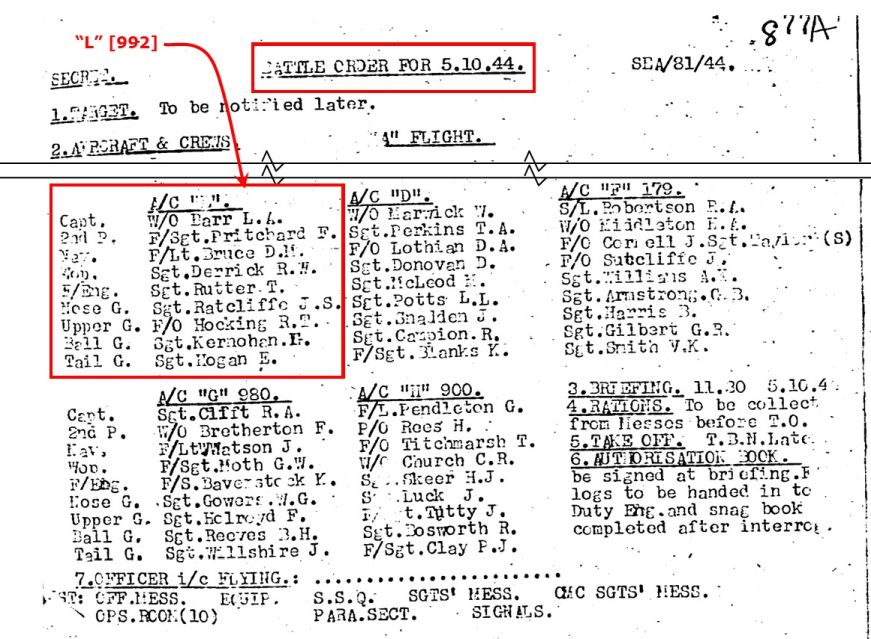
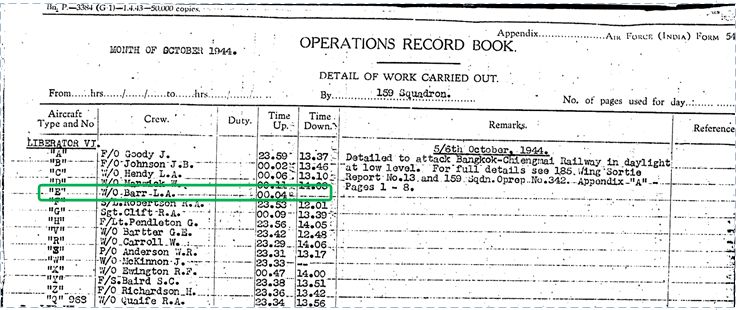
On a low-level bombing run6 on the Ban Dara Railway Bridge,7 the B-24 was hit by ground fire and immediately caught fire. The captain was able to gain sufficient altitude for five crew members to parachute safely to ground; four others were killed either in the attack or the subsequent crash of the plane. The plane was recorded as not having returned, as”Time Down” was left blank:8
The survivors were eventually sent to a Thai-controlled “internment” facility.9
Survivors:
Leo Arthur Barr (417002)
Reginald Thomas Hocking (407291)
Ronald W Derrick (1318896)
TW Rutter (1803261)
David McDonald Bruce (CAN.J12276)
Casualties: no known graves. Names are listed in the columns at the Singapore Memorial:
John Arthur NELSON (423854; Column 444)
John Squire RATCLIFFE (1894746; Column 435)
Clive Symes SWAN (416627; Column 443)
Patrick HOGAN (1522977;* Column 436)
The wreckage can be assumed to have eventually found its way into a Japanese scrap metal drive.10
References:
• Allied Eastern Air Command Weekly Intelligence Summary, 13 Oct 1944:11
Section I. Resume of Daily Air Operations, p 7:
06 Oct – Two Liberators of 159 Squadron missing from low level attack on Bangkok-Chiengmai railway [one of those being BZ992].
Section V. AA Fire Encountered-Week Ending 08 October 1944, p 3 [and see Captain Bantao Punsri, directly below]:
Date: 6/10
Time: –
Place: DARA Bridge
Type: [Machine Gun] Height: –
Accuracy: Acc.
Intensity: –
Reported by: 159 Sq. Libs
Remarks and Comments: From S end bridge. 2 a/c damaged [again, one of those being BZ992] . . . .
• Captain Bantao Punsri, Royal Thai Army, 200112
Translation:
Later Allied aircraft were attacking bridges, especially the one at Ban Dara, on the railway to the north. I was put in charge of installing anti-aircraft guns on the train and at the foot of Ban Dara bridge. The one on the train had a tripod mount which made it difficult to swivel round; so I got permission to change the tripod stand to a monopod so that I could turn the gun round when I shot. It worked so well that I shot a B-24 down at Uttaradit, and the gun at Ban Dara shot down another B-24. We took two prisoners at Uttaradit and five from Ban Dara; 15 were killed. [page 69]
His wife added details:
Translation:
Khun Bantao told me long ago that he had thought about how to improve a gun sight. He wanted it to be larger so that he could see a target more clearly: the one originally provided with the gun was a small square sight and he developed a larger oval one to replace it using rod from an umbrella frame. He told me about the number of prisoners and deaths from aircraft that had been shot down. He informed his commander in a telegram (which a kind soldier showed me so that I didn’t need to worry about my husband) that he suspected two more aircraft had been shot down because he saw them leaving the target trailing flames. He learned later that he was right: one had been shot down at the border and another went down in the sea. [page 71]
Comments:
•The two B-24s, BZ292 (here) and EV940 (over Uttaradit) were clearly brought down by ground fire, presumably faciliated by Bantao’s innovation.
• The one that went down in the sea was presumably BZ978, also a possible victim (delayed) of ground fire, though not named in messages from BZ978 before it ditched (Umemoto doesn’t commit to an identity for the “Shooter” of BZ978, leaving it to a Ki-43 or AA fire).
• But the aircraft reportedly shot down at the border is an unknown, unless it is describing BZ992 which went down near the provincial border with Phitsanulok; in which case, the downing was double counted.


• Ozel, Thai Air Accidents (offsite link), p 2:
Just before midnight on 05Oct44, 16 Liberators from 159 Sqdn took off for a low level raid on the railway just north of Bangkok. . . . As they arrived just after dawn on 06Oct44, they were attacked by Ki-43 fighters from the Japanese 50th and 64th Sentai. The Japanese made two claims, one by Sgt. A. Kato and a second one by Cpls Yamaguchi, Ikeda, R. Yamamoto and W. Niwa. According to Kato the bomber he was firing at suddenly swerved and hit a second one, both going down, reportedly in the Bay of Bengal, north of Cape Negrais.
From BZ978, 5 killed . . . 3 survived . . . .
From BZ992, 4 killed (Patrick Hogan, George Kernohan, Kenneth Gordon Prichard & John Squire Ratcliffe); 5 bailed out and survived as POW’s (Leo Arthur Barr, David McDonald Bruce, Reginald Thomas Hocking, T. W. Rutter & Ronald W. Derrick)
Comment:
available accounts from RAF crews and Umemoto’s text do not support Japanese pilot Kato’s claim that RAF aircraft were involved in a mid-air collision.
• Royal Air Force Commands: Liberator BZ992, Sep 2019 (offsite link)13
Liberator BZ992
Aircraft Accident / Loss Entry
Date of Crash: 06 Oct 44
Aircraft name: Liberator VI
Serial Number: BZ992
Unit: 159 SqdnMissing from attack on Siam-Burma railway.
Takeoff 0001hrs. Detailed to attack Bangkok-Chiang Mai railway targets in daylight at low level. At approximately 0615 hrs ground fire from the defense of Ban Dara Bridge, Siam ignited the aircraft. The skipper, 417002 W/O Leo Arthur Barr RNZAF, gained height to about 800 feet and five, including W/O Barr, were able to bail out and land safely. The other four members either died in the aircraft or in the resultant crash; they have no known graves. Local villagers turned the five survivors over to the local police, with no ill treatment. Japanese soldiers tried to persuade the Thai police to turn over the prisoners, but in the confusion of a Liberator attack the police spirited the airmen to safety. Turned over to the Siamese army on 7 Oct, the men were sent to internment in Bangkok where they were released on 20 August 1945. They were treated well in Thai custody.
Extracts from an affidavit of David Bruce, BZ992 navigator (with affidavit in full available following Shores’ review below):14
On October 6, 1944, I was attached to 159 Squadron, RAF Group 231, operating from Digri, Bengal. We were flying Liberators. At 0001 hours we took off to do a low level attack on railways in Northern Siam. The crew was composed of myself as navigator and bomb aimer; Warrant Officer Barr as first pilot (RNZAF); Flying Officer Hocking, RAAF, as mid-upper gunner; Sergeant Derrick, RAF, as wireless operator; Sergeant Rutter, RAF, as flight engineer; Sergeant Kernohan, RAF, as ball gunner; Sergeant Kenneth Prichard, RAF, second pilot and Sgts John Ratcliffe and Patrick Hogan.
At approximately 0615 hours ground fire from the defence of Ban Dara Bridge, near Ban Dara town, N17°22.42 E100°04.60, ignited our aircraft and the skipper gained height to about 800 feet and five of us were able to bale out and landed safely. The other four members either died in the aircraft or in the resultant crash.
The five of us who landed safely were Barr, Hocking, Derrick, Rutter and myself. We were captured by local villagers and we eventually ended up in a European Internment Camp in Bangkok. We were soon joined by the two surviving crew members of BZ978 which had been shot down during the same raid.
• Shores, 2005:15
Saturday, 07 October 1944
During the last minute of the previous day, 16 Liberators of 159 Squadron took off for a raid on the railway north of Bangkok at low level; they were joined by eight more bombers from 355 and 356 Squadrons. . . .
204th Sentai pilots claimed another Liberator near Bangkok, and yet another was claimed by AA crews. . . .
Comments:
• The date is incorrect per review in footnote 1.
• BZ992 is recorded by affidavit of crew member as having been brought down by ground fire, possibly the aircraft here credited to anti-aircraft crews (claim for “another Liberator near Bangkok” is not supported by RAF records).
• David Bruce, BZ992 navigator (Toronto Star, 08 December 1944):16
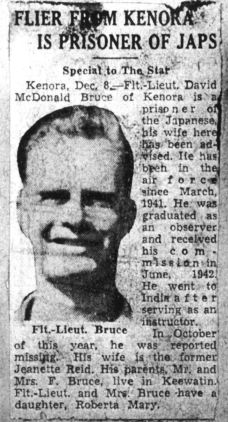
• Post-war affidavit of David Bruce, BZ992 navigator, 194617
AFFIDAVIT
- I am Ex-F/L CAN.J12276 David McDonald Bruce, permanently residing at 445-3rd St. Kenora, Ontario. I am presently employed by John Kron & Son, at Kenora.
- I was born on October 25, 1912, at Oldmeldrum, Aberdeen, Scotland. I enlisted in the R.C.A.F. on March 4, 1941, and was discharged at No. 5 Release Centre, Winnipeg, on January 8, 1946.
- On October 6, 1944, I was attached to No. 159 Squadron, RAF Group 231, operating from Digri, Bengal. We were flying Liberators. At 0001 hours that date we took off to do a low level attack on railways in Northern Siam. The crew as composed of myself as navigator and bomb aimer; Warrant Officer Barr as first pilot (RNZAF); Flying Officer Hocking, RAAF, as mid-upper gunner; Sergeant Derrick, RAF, as wireless operator; Sergeant Rutter, RAF, as flight engineer; Sergeant Kernohan, RAF, as rear gunner [listed as ball gunner in 159 records]; Sergeant Richards [error, should be Kenneth. Prichard, per 159 Sqn records and CWGC database], RAF, second pilot and two other members of the crew whose names I cannot presently recall. [Sgt John Ratcliffe and Sgt Patrick Hogan. Full details at end.]
- At approximately 0615 hours ground fire from the defence of Ban Dara Bridge [near Ban Dara town, which is located at 17° 22′ 25” N, 100° 04′ 36” E] ignited our aircraft and the skipper gained height to about 800 feet and five of us were able to bale out and landed safely. The other four members either died in the aircraft or in the resultant crash.
- The five of us who landed safely were Barr, Hocking, Derrick, Rutter and myself. On landing I immediately hid my parachute in the bush and made my way away from the crashed aircraft. However, within approximately 2 1/2 hours the villagers had tracked me down and I was taken prisoner by native Siamese. The others fared approximately the same way with the exception of Barr who was not captured until the following day.
- The four of us who were captured on that date were turned over to the local police by the villagers. None of the four of us were ill-treated by the villagers or the police. While in the hands of the police and being escorted to the railroad station we were intercepted by three Japanese soldiers; one officer and two other ranks, who endeavored to persuade the Siamese to turn us over to them. This the Siamese were reluctant to do. While this discussion was going on between the Japanese and the Siamese as to our disposal a Liberator attack forced everyone to cover. The Japanese scurried in one direction and we with the Siamese police went in another.
- We were hidden in the jungle for the balance of that day and until 0200 hours on the 7th when we were again taken to the railway station and went by hand-car to Pitsamulok, where we were turned over to the Siamese army at their local barracks.
- Shortly after our arrival at the military barracks the Japanese were informed of our presence there and they, the Japanese, sent over three interrogation officers for the purpose of interrogating us. This interrogation lasted for approximately five hours and was interspersed with threats, but no actual physical action was taken against any one of us. The Japanese gained no information from any of us.
- On the morning of October 8th we were escorted by the Siamese by boat to Bangkok where we were place in the European Internment Camp on the 10th.
- The internment camp was composed of approximately 200 other nationals and we were kept apart from the internees by being confined in a guarded room. There were seven of us all told in this room. In addition to the four of us, Barr later joined us and two other members of a crew that had been shot down on the same date as we had been. The room we were placed in was sufficiently large and our diet consisted of the normal fare of the East and we were subjected to no ill-treatment.
- After 2 1/2 months in the internment camp a proper P.O.W. camp was constructed adjoining, and we were all placed in it. This P.O.W. camp was operated by the Siamese and our meals were sent over to us from the internment camp. Here in this P.O.W. camp we were given freedom within the bounds of the camp which allowed us to participate in outdoor exercises and sport.
- At frequent intervals during our first six weeks in Bangkok we were interrogated by Japanese officers. During these interrogating periods threats were again offered but no violence was ever committed.
- On March 5, 1945, the P.O.W. camp and internment camp were bombed out by Allied bombings and about six weeks later we moved to another site in Bangkok where we remained until we were released on August 20, 1945.
- The Deputy Camp commandant of the P.O.W. camp at both locations in Bangkok was Major Chackrabandhu of the Siamese army. His treatment of the prisoners was considered extremely good.
- At no time did there ever come to my knowledge any mistreatment of prisoners or any violations of the Geneva Treaty committed as far as I know.
- Escape from the actual compound which comprised the P.O.W. camp could have been effected at any time with reasonable safety. However, due to the lack of transportation facilities out of the country, myself and comrades never actually made an escape break. We were constantly trying to “promote” means of transportation and a Mr. Knudsen, General Manager of the Thai Electric offered us unlimited amounts of money if it could be used for the purpose of purchasing boats or any other means of transportation. In the latter days at the camp, when the Siamese had begun to realize the trend of the war I, ineffectually tried to get the Siamese Air Force to fly me out. Two of my fellow prisoners, Americans, had their escape engineered for them by the American underground which was becoming active at that time.
AND I have signed
{signature of D. M. Bruce}
SWORN before me at Kenora, Ontario, this 12th day of March, 1945. [1946, most likely.]
{signature of B. C. Andrew}
(B. C. Andrew) Wing Commander,
No. 2 Air Command Headquarters, RCAF,
WINNIPEG, Manitoba.
A second, detailed narrative, by William A Pugh is available at RAF Memoirs of SE Asia 358 Squadron at Jessore, India (offsite link).
• Umemoto, 2002:18
Umemoto comment:19
翌10月6日、5時30分(現地時間、日本時間なら8時、以下同)、目標上空に達した第159飛行隊 のB24は爆撃を開始。リベレーターは編隊を組まず、単機ずつで攻撃を行った。まず、バール准尉のB 24が行方不明になった。だが、38日後、バール機の搭乗者8名のぅち、3名が捕虜になっていることが 判明した。
Translation:
The following morning, October 6, at 5:30 (local time . . .), 159th Squadron B-24s reached the target area and started attacking. The Liberators did not maintain any formation, but one aircraft simply followed another in to attack each target. Warrant Officer Barr’s B-24 [BZ992, targeting Ban Dara] first went missing. 38 days later, it was discovered that three of the eight crewmembers on the Barr plane had been taken prisoner.
Comments:
• In the event table,
• The “Shooter” is identified as either a Ki-43 which would have been flown by the IJAAF or ground-based anti-aircraft fire. No pilot’s name is potentially credited for the shootdown.
• In “Details”, the death count of “5” differs from RAF records which show 4, while the number of crewmembers interned, 3, differs from RAF records which show 5.
• In the text,
• The text continues with the error of three, not five successfully bailing out.
• The text does not address the reason for giving a choice of “Shooters” in the event table.
Summary of On-site Investigations, 2022
The demise of BZ992 is summarized in the somewhat ambiguous map below on the left, translated on the right, with relevant items circled in green:20
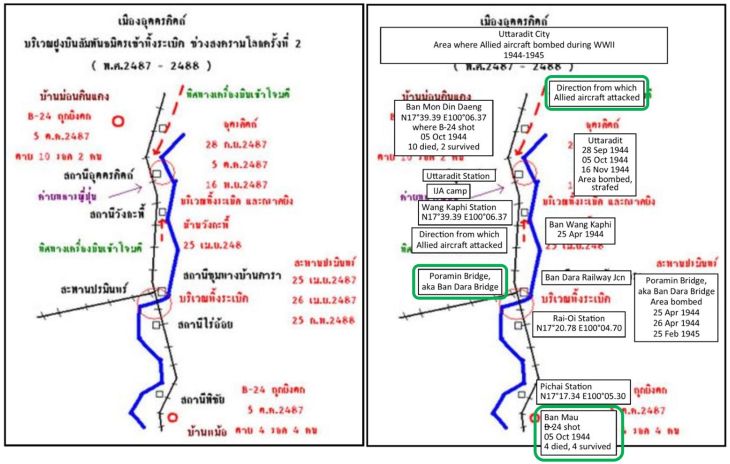
Almost all of the following was made possible only because of guidance provided by responses to Ben Svasti’s Facebook queries targeting the Ban Dara area.
BZ992 was hit just north of the Ban Dara Bridge and the plane spewed pieces as it approached the bridge:21
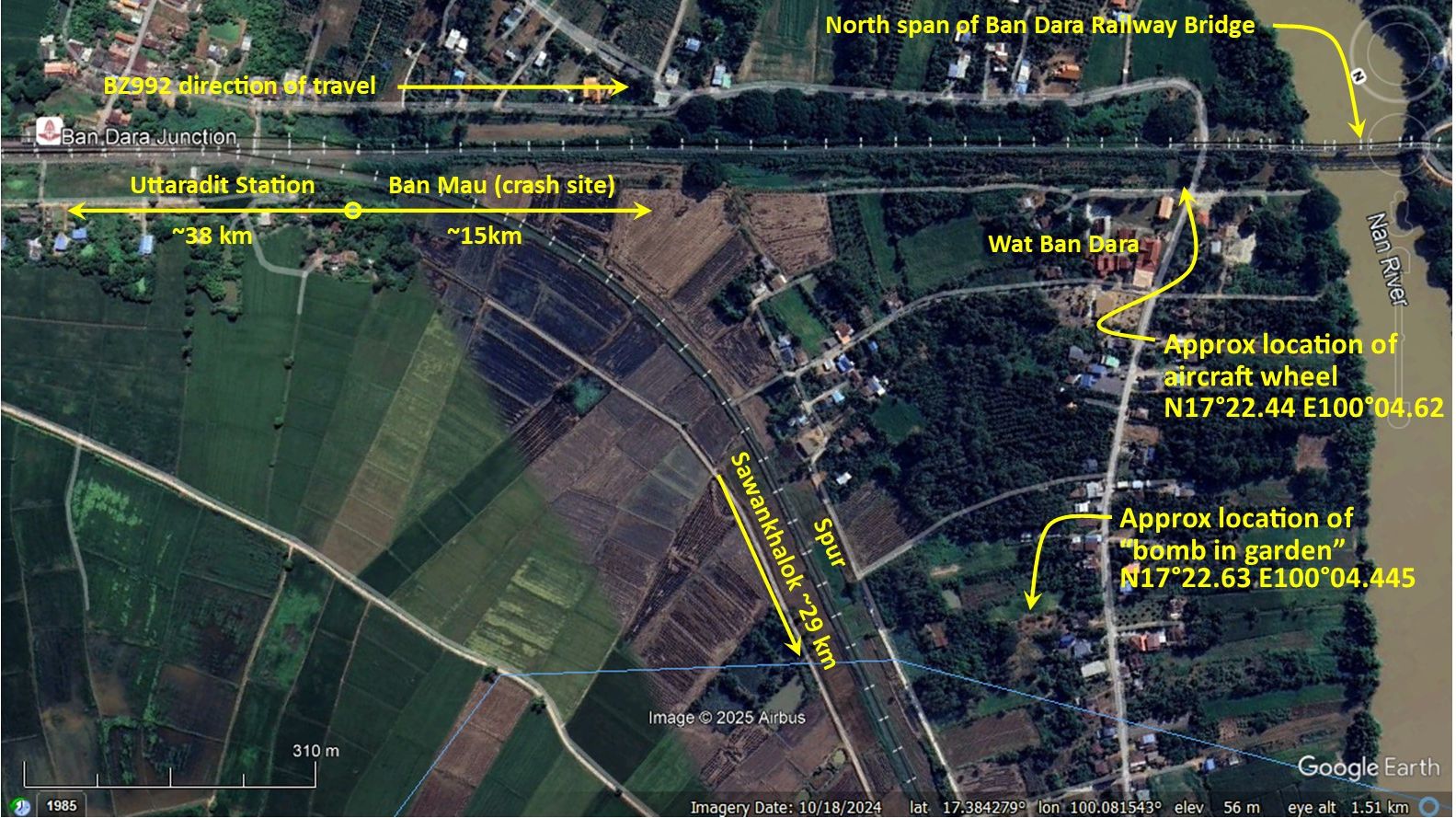
On the south side of the river, Ben Svasti was told of a farmer who had unearthed what appeared to be an aircraft’s wheel attached to undercarriage some twenty years ago. The assembly was buried too deep and was too heavy for the farmer to dig out; since the land belongs to the State Railway of Thailand and is no longer farmed, the wreckage is assumed to still be there.22
Witness 1. Bpanyee Waiyagoon (ปั้นหยี ไวยกูล), residing near the north side of the Ban Dara Bridge23
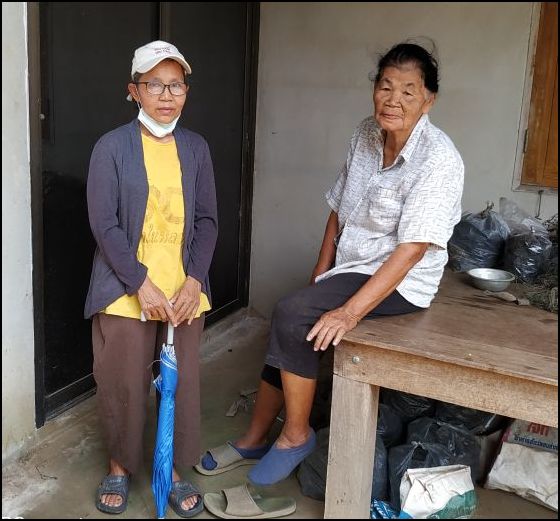
Nurse Paunapa Lek-aroon (พรนภา เล็กอรุณ, left) with her aunt, Bpanyee Waiyagoon (ปั้นหยี ไวยกูล), in her 80s, who saw a plane fly over Ban Dara in flames when she was 6 years old. Nurse Paunapa herself recalls, as a child, that she used to “ride” a bomb that was in her aunt’s garden (Google Maps link) 24 and led us to its location (the bomb is now, of course, long gone). She indicated to Ben Svasti that she had in earlier years seen flywheels, plane parts, bomb-like fragments scattered about.25 She also pointed out where an aircraft wheel had been discovered by a farmer.
Witness 2. Gimrai Lo-bprasert (surname: โล่ห์ประเสิรฐ), residing near the Ban Dara Railway Junction on the north side of the Ban Dara Bridge26

Retired teacher, Wichai Lo-bprasert (วิชัย โล่ห์ประเสิรฐ, left), with his sister-in-law, Gimrai Lo-bprasert, in her 90s at her house (Google Maps link).27 Born on the north side of the river and raised in the wat area there, she moved to the south side during the war after “bad” locals, for reasons unclear, burned the local sala and market, forcing vendors to go door-to-door to sell goods. A bunker on the south side helped make her move more logical, as well as the presence of IJA and RTA troop encampments. With damage to the bridge, train passengers had to walk and goods trundled from a train halted on one side of the bridge to another train waiting on the opposite side. She helped sell food to train passengers on both sides as well as the IJA troops. Her worst memories were of the 25 April 1944 attack which killed many locals. With the end of the war, one IJA soldier didn’t want to return to Japan and hid under her house, but was caught and forced to leave.
Witness 3. Mungaun Lo-bprasert (มังกร โล่ห์ประเสิรฐ) residing near the Ban Dara Railway Junction on the north side of the Ban Dara Bridge28
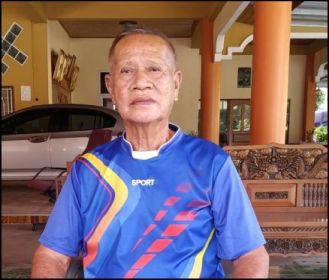
Mungaun Lo-bprasert (มังกร โล่ห์ประเสิรฐ), elder brother of the retired teacher, Wichai Lo-bprasert, in his 80s, lived just up the street (Google Maps link). He recalled that IJA troops had been located at both ends of the railway bridge. With warnings of attacks, locals were advised to move away from the bridge area. They were told not to cook during the day because smoke might help enemy aircraft locate the bridge (apparently light from fires at night weren’t considered a problem). He confirmed that a plane that had tried to bomb the bridge crashed far south of the bridge. After Japan’s surrender, IJA soldiers came to thank his mother for providing food; theirs was a very emotional parting. Following the war, locals put up a temporary structure to allow foot traffic to cross over the bridge; a ferry service also developed.
:
| First published on Internet | ||
| Crewmen list added | ||
| Converted to WordPress by Ally Taylor | ||
| Updated, site investigation results added, author errors & typos corrected | ||
Last Updated on 1 September 2026
- Dates recorded for the event are not consistent, and that seems partly a function of the flight having taken off around midnight:
Royal Air Force Commands: Liberator EV940 records 06 Oct 1944, and is assumed to be at least approximately correct per data on a companion B-24 in “Circumstantial report for Liberator “W” 978 – missing from operations on morning of 06 Oct 1944″, Item 4: “The aircraft took off from Digri as briefed at 23.33 hrs. 5.10.44.”
Umemoto [梅本弘, ビルマ航空戦・上 [Air War in Burma, Vol 2] (Tokyo: Dai Nippon, 2002)], p 519, line 4, records 06 Oct (MIA on attack on Bangkok-Chiengmai railrway, Thailand/Burma).
USAF Serial Number Search Results (offsite link) records EV 940 (Consolidated No 64088) as “Lost Oct 8, 1944”.
Shores appears to use 07 Oct 1944 [Shores, Christopher, Bloody Shambles, Vol Three (London: Grub Street, 2005), p 270 (see References below).[↩]
- Liberator B.VI was the RAF designation for Consolidated B-24Js delivered to the RAF under Lend-Lease (Joseph F. Baugher (website no longer active).[↩]
- N22°46.93 E87°21.99: coordinates per Digri Airfield (Wikimapia offsite link), about 100 km WNW of Kolkata (Calcutta). See also Midnapore District article, Digri Airfield, India (offsite link); Photo that follows is from ww2aircraft.com: Liberator B VI (offsite link).[↩]
- Extract from Google Maps; annotated by author with Microsoft Publisher. The waypoint shown, Cheduba Island (N18°52 E93°29), is an assumption since a USAAF B-24 flying to bomb Kuang Luang Bridge on 21 Nov 1944 used Sagu Island (Google Maps link to present-day Saku Insel Island) on the east side of a channel from Cheduba, while an RAF Liberator B.VI which crashed near Nakhon Sawan on 29 May 1945 is recorded as having used Cheduba. My ref: \02500 Tango\_Crash sites N TH for Tango\DETAIL SHEETS\A441006 Ban Dara-BZ992 REDO [A07]\Webpage 1\Flight plan.pub[↩]
- Provided by Matt Poole email of 07 Mar 2022; my ref: \02500 Tango\_Crash sites N TH for Tango\DETAIL SHEETS\A441006 _events\Emails-Matt\20220307 Matt Poole\WeTransfer\Scan_0108.tif: WeT 992.pub, sht 3 pt.[↩]
- Possibly in applying a version of “skip bombing” as described in Dive, Glide, & Skip Bombing (offsite link) [↩]
- N17°22.34 E100°04.60, coordinates per Google Earth.[↩]
- Provided by Matt Poole email of 07 Mar 2022; my ref: \02500 Tango\_Crash sites N TH for Tango\DETAIL SHEETS\A441006 _events\Emails-Matt\20220307 Matt Poole\WeTransfer\Scan_0637.tif: excerpt BZ992.pub sht2a. jpg[↩]
- Royal Air Force Commands: Liberator BZ992 (offsite link). *But note that while an affidavit (excerpted in the Text below) states four casualties, the website only names three; Matt Poole adds a fourth: HOGAN.
And see Essex New War Memorial (offsite link) which differs, replacing:
Nelson
Swanwith these two, both recorded dead as 06 Oct 1944, but not referenced to any plane:
PRICHARD (1324322) [Singapore Memorial, Column 436] KERNOHAN (1796515) [Singapore Memorial, Column 436]
but note that RAF Commands lists these two in the BZ978 crew. Essex offers no reference for its version.[↩]
- As described in ชีวิตของมาซาโอะ เชโตะ ผู้ถูกพ่อและญี่ปุ่นทอตทิ้ง เล่ม 1, แปลจาก : Seto Masao no Jinsel (ชีวิตของมาซาโอะ เชโตะ), แปลโดย : บ้ณทิต ประดิษฐานุวงษ์ [Seto, Masao, Life of Masao Seto, Book 1, p 160 [my ref: 03400 Boggett/Seto xlatn].[↩]
- Excerpt from Eastern Air Command Weekly Intelligence Summary (aka EAC-WIS), 13 Oct 1944, Section I, page 7, and Section V, page 3, from the US Air Force Historical Research Agency, Maxwell AFB, AL, provided by Sakpinit Promthep email of 01:00 13 Dec 21.[↩]
- Memorial of the Royal Cremation Ceremony of Air Chief Marshal Ajai Punsri, M.D., TCSC (offsite link in Thai), 25 Sep 2001, pp 69, 71; per Sakpinit Promthep email of 18:00 12 Dec 2021; translated by Wiyada Kantarod.[↩]
- More information is available at “Related Posts” in RAF Commands, Liberator BZ992 (offsite link) webpage with input relevant here by Matt Poole.[↩]
- Matt Poole, RAF Thread: POWs held in Thailand (offsite link), 10 Sep 2019.[↩]
- Shores, ibid, p 270.[↩]
- provided by Matt Poole as received from David Bruce’s brother Doug via Robert Quirk in Canada; my ref: \02500 Tango\_Crash sites N TH for Tango\DETAIL SHEETS\A441006 _events\Emails-Matt\20220307 Matt Poole\WeTransfer\BZ992 Bruce,Dave,TorontoStar-r.jpg[↩]
- provided by Matt Poole as received from David Bruce’s brother Doug: \02500 Tango\_Crash sites N TH for Tango\DETAIL SHEETS\A441006 _events\Emails-Matt\20220307 Matt Poole\BZ992 and EV940, lost 6Oct44BEST.doc[↩]
- Umemoto, ibid, p 519, line 6. Translated by Google Translate, edited by author.[↩]
- Umemoto, ibid, p 293. Translated by Google Translate, edited by author.[↩]
- Original source lost; my ref: \02500 Tango\_Crash sites N TH for Tango\DETAIL SHEETS\A441006 _events\Visit 20220314-18\Ban Dara RR map overlay-a.jpg[↩]
- Google Earth view, annotated by author using Microsoft Publisher; my ref: \02500 Tango\_Crash sites N TH for Tango\DETAIL SHEETS\A441006 _events\Emails-Ben\_Ban Dara RR map overlay.jpg: _Ban%20Dara%20RR%20map%20overlay.pub, Sht 5[↩]
- Svasti email of 08:18 11 Mar 2022[↩]
- Photo by author (my ref: \02500 Tango\_Crash sites N TH for Tango\DETAIL SHEETS\A441006 _events\Visit 20220314-18\20220318 Ban Dara Jcn (retired nurse)\Original photos,notes\IMG_20220318_120710 pt.jpg) [↩]
- N17°22.630 E100°04.445[↩]
- Ben Svasti email to author 15:26 08 Mar 2022[↩]
- Photo by author (my ref: \02500 Tango\_Crash sites N TH for Tango\DETAIL SHEETS\A441006 _events\Visit 20220314-18\20220317 1500 retired teachr etal\Original photos,notes\IMG_20220317_155129 pt.jpg) [↩]
- N17°22.936 E100°04.991[↩]
- Photo by author (my ref: ((\02500 Tango\_Crash sites N TH for Tango\DETAIL SHEETS\A441006 _events\Visit 20220314-18\20220317 1500 retired teachr etal\Original photos,notes\IMG_20220317_161707 pt.jpg[↩]