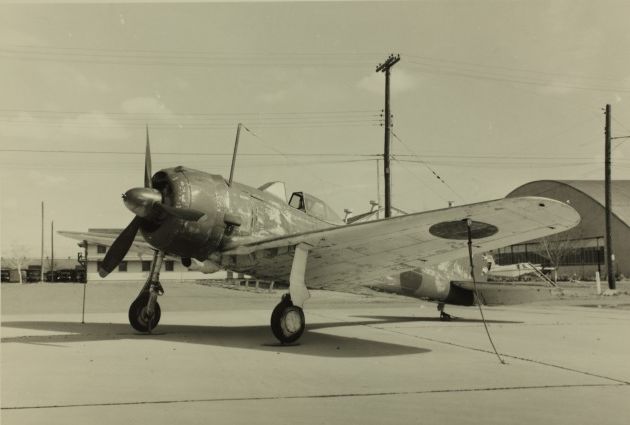
06 October 1944:1 Information about a Ki-43 which chased RAF BZ978 Liberator after it had attacked targets in the Uttaradit area are very sketchy. Three sources are available and they don’t mesh very well. The established Japanese source for aircraft losses in the Burma area is Umemoto and the detail he was able to provide in this instance implies that Japanese records are very limited. RAF records rely on radio transmissions from the BZ978 Liberator after its attack on Uttaradit and are confusing because of their hodge-podge nature.
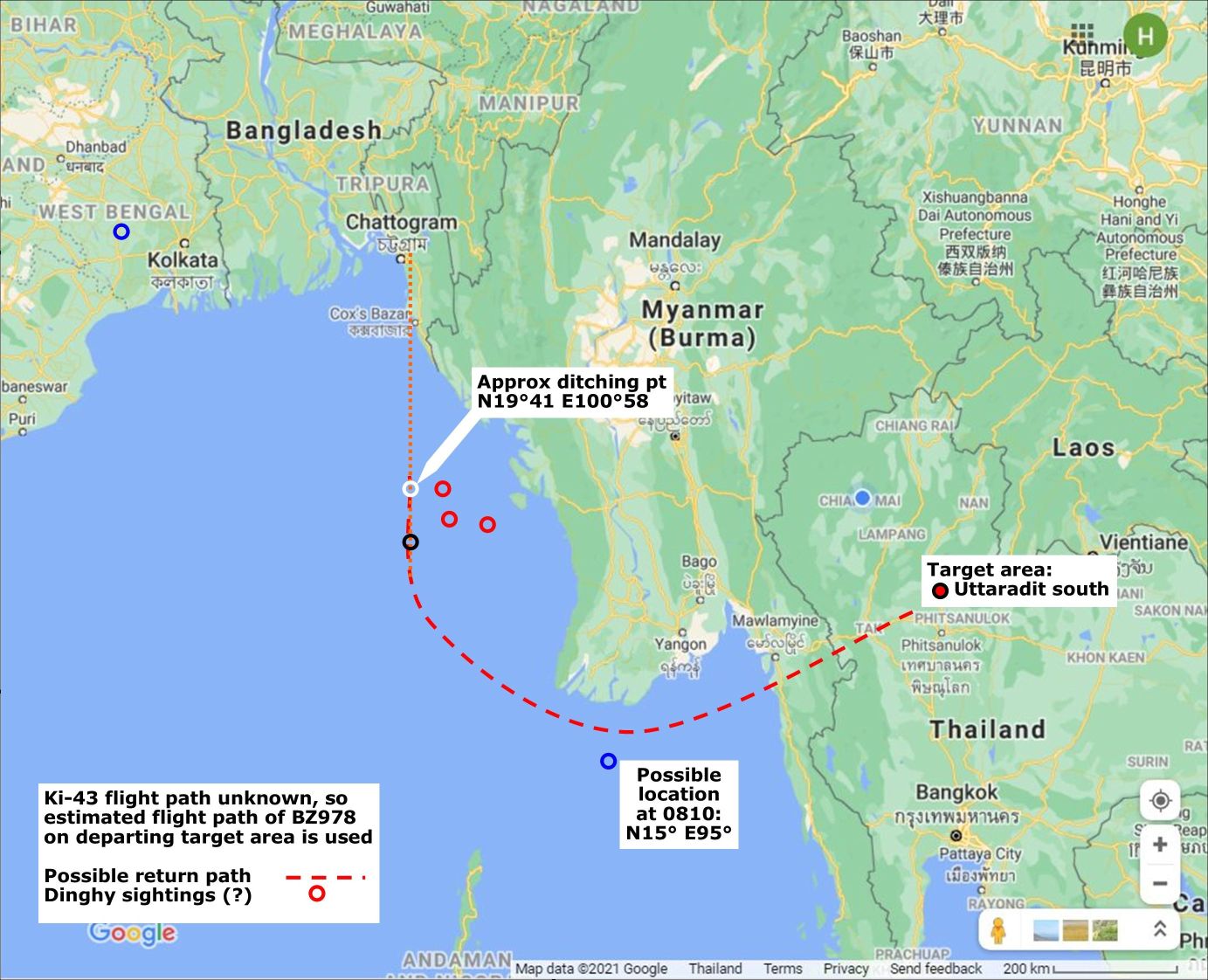
A flight of 204th Sentai Ki-43s came from Don Muang Airfield in response to a bomber raid on the Uttaradit area by 16 B-24 Liberators from RAF 159 Squadron which included BZ978. Where the Ki-43s first engaged the Allied aircraft is unclear. The assumed flight path of BZ978 is traced below as the only information about the course of the Ki-43 that eventually crashed in the Andaman Sea:
References:
- Umemoto:2
p 519, line 7:
| Item | Japanese | English3 |
| Date | 10月6日 | 06 Oct [1944] |
| Unit | 204 | 204th Sentai |
| Aircraft lost | 一式戦II型 | Ki-43 II “Hayabusa” Fighter |
| Pilot | 笹田弘曹長 | Master Sergeant Sasada |
| Location | アンダマン海 | Andaman Sea |
| Shooter | B-24との交戦 | Combat with a B-24 |
| Details | 墜落.戦死 | Crashed. Killed in action |
[near top of 2:292]
タイのドムアン飛行場にいた204戦隊の一式戦は、リベレータ—8機(日本側判断)の来襲に対し て離陸、海上まで追跡、擊墜1機を報じたが、笹田弘曹長の一式戦が被弾、インド洋に墜落、戦死した。
Translation:
In response to reports of an attack by eight Liberators (judged by the Japanese side), [IJAAF] 204th Squadron aircraft took off from Don Muang Airfield in Thailand, chased them to the sea, where one Liberator crashed. Sergeant Master Sergeant Sasada’s aircraft was hit and fatally crashed in the Indian Ocean [Bay of Bengal].
Umemoto, 2002, in describing the B-24 that had been attacked:
p 293:
8時30分、帰途についたジョン.マッキノン准尉機は、アンダマン海上で、日本戦闘機と交戦中、 エンジン2基が停止と報告。。。。
Translation:
At 8:30, Warrant Officer John MacKinnon’s aircraft, on its return journey, reported that two engines had failed while engaging Japanese fighter planes over the Andaman Sea. . . .
Comment: Umemoto ties the B-24’s damage to an attack by two Japanese aircraft over the Andaman Sea / Bay of Bengal. This doesn’t match the information radioed by BZ978 in the report below. No source is provided for this version.
- Allied “Circumstantial Report” on the loss of BZ978 (excerpts):4
I. CIRCUMSTANCES
. . . 5. The three other aircraft which were on the same section of the line as Liberator “W” attacked between 05.25 and 06.18 hrs. at heights varying from 100 to 500 ft.
6. Liberator “W” 978 failed to return to base.
II. SIGNALS RECEIVED
1. At 08.10 hours Liberator “W” broadcast “SOS S.O.S.” followed by “333” to which Base Control at Digri replied by asking if they had any further message.
2. At about this time another aircraft of this Squadron who were receiving the signals very loud and clear, thinking that they were in the vicinity passed an approximate position of 15 00’N. 95 00’E.
3. At 08.37 hrs. R.A.F. Salboni gave a second class Q.D.M. [a standard Q-code that represents the magnetic bearing from the aircraft to a radio station (or navigational beacon)] of 315 deg. [essentially on a line to N15 E95]
[8 min later, after QDM, directly S of Chittagong, 19 nm, N18 29 E91 47]
4. At 08.45 hrs. Liberator “W” 978 called Digri with the following message “Trying CHITTAGONG – Two engines u/s. Height 5000′ A.S.I. 140 [Air Speed Indicator 140 MPH] D. 360 deg [Direction 360 degrees, or due north]”.
5. At 09.09 hours it called again with “Unable to receive due to heavy interference”.
[35 min after msg abt Chittagong: 82 nm, N19 32 E91 47]
6. Finally at 09.20 hrs. it sent the following message which Digri received “Attacked by two fighters over target, one dead, three wounded”. This message ceased at 09.25 hours and was the last transmission heard.
[40 min after msg abt Chittagong: 93 nm, N 19 43 E91 47]
7. At 09.34 hrs. Digri sent a message asking for the aircraft’s position but no contact was made.
8. At 10.30 hrs. Digri ceased listening on night frequency for any further messages.
9. It is stressed that no signals were received from Liberator “W” indicating that it was in any trouble until the signal advising that it had two engines out. These were most probably damaged in the attack carried out by the two enemy fighters.
III. AIR-SEA RESCUE SEARCH
1. A.S.R. [Air Search and Rescue] Search was immediately instituted by aircraft of No. 224 Grp. at 15 00’N 95 00’E, the position at which the Liberator was believed to have ditched.
[Positions of possible sightings of a dinghy, however, were recorded at N18°30 E92°30, N18°55, 92°22, and N18°25, E93°05, though no rescue could be made. The locations are shown approximately on the map above as small red circles. The only useful information to be gleaned from these locations is that they would have been somewhere north of the fatal crash site of Master Sergeant Sasada’s Ki-43.
Thus Sasada crashed somewhere between where BZ978 left the coastline (~N15°50 E97°40) and a dinghy was sighted (~N18°55 E92°22).
- Ozel, Thai Air Accidents (offsite link), p 2:
Just before midnight on 05 Oct 1944, 16 Liberators from 159 Sqdn took off for a low level raid on the railway just north of Bangkok. . . . As they arrived just after dawn on 06 Oct 1944, they were attacked by Ki-43 fighters from the Japanese 50th and 64th Sentai. The Japanese made two claims, one by Sgt A Kato and a second one by Cpls Yamaguchi, Ikeda, R Yamamoto, and W Niwa. According to Kato, the bomber he was firing at suddenly swerved and hit a second one, both going down, reportedly in the Bay of Bengal, north of Cape Negrais.
Comments:
• Available accounts from RAF crews and Umemoto’s text do not support Japanese pilot Kato’s description of two RAF aircraft colliding in mid-air.
• Note that Umemoto (below) identifies the squadron of the aircraft possibly credited with downing BZ978 as the 204th, rather than the 50th or 64th; and he does not identify the pilot (here Kato) who might have brought down BZ978.
• Ozel does not provide a source for Kato’s claim.
As noted above, information provided by Japanese and Allied forces aren’t consistent among the three.
| First published on Internet | ||
Last Updated on 17 September 2026
- Original file (630×425 px) By San Diego Air & Space Museum Archives – https://www.flickr.com/photos/sdasmarchives/16336680345/, Public Domain, https://commons.wikimedia.org/w/index.php?curid=41501561 (offsite link) [↩]
- 梅本弘,ビルマ航空戦 (東京:大日本印刷株, 2002) [Umemoto, Hiroshi, Air War in Burma, vol 2 (Tokyo: Dai Nippon, 2002)] hereafter, Umemoto[↩]
- Google translation[↩]
- Memo to BPO ACSEA, dated 02 November 1944. Ref: 1898/S.402/24/p.1, signed by Blackburn, Wing Commander, no 195 Squadron, RAF; formerly carried under Liberator serial BZ978 thread in Roayl Air Force Commands, but now withdrawn without any backup on Wayback Machine (www.rafcommands.com/forum/showthread.php?2110-Liberator-serial-BZ978/page2&p=11150#post11150); my ref: \02500 Tango\_Crash sites N TH for Tango\DETAIL SHEETS\A441006 Bay of Bengal-BZ978 REDO (A06A)\Circumstances rpt.txt[↩]