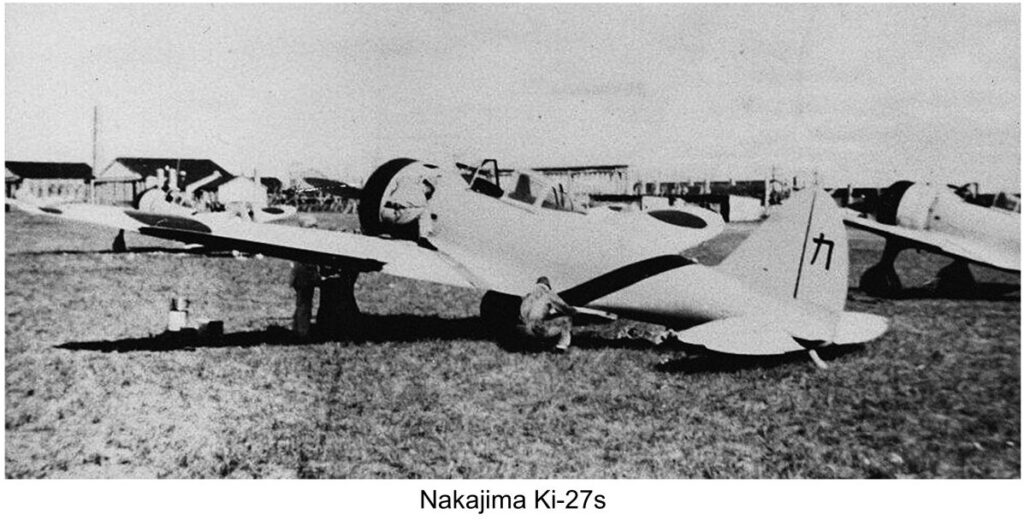
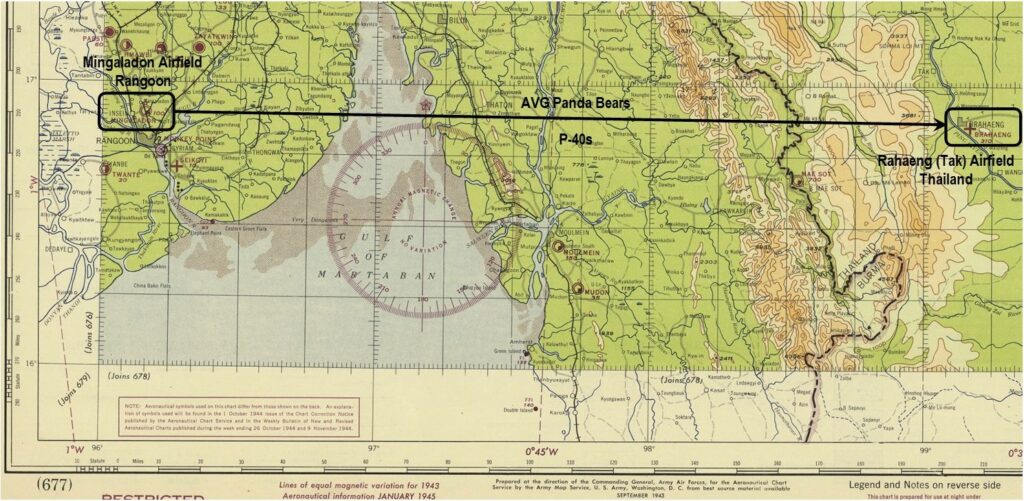
 09 Jan 1942: One IJAAF Ki-27 was destroyed and another badly damaged on the ground at Rahaeng (Tak) Airfield1 (Google Maps links to location of older runway, now abandoned with site redeveloped) by strafing from AVG 2nd Squadron P-40s and RAF 67 Squadron Buffalos. The Flying Tigers Panda Bears continued “taking the war to the enemy” under their leader, Jack Newkirk, flying out of Mingaladon (Google Maps link) in Rangoon with this third attack on Rahaeng Airfield in six days.2
. . .
Map: Rangoon (Google Maps link) is roughly 330 km west of Rahaeng.3
References:
- Senshi Sosho 34:4
pp 592-606: await translation
- Umemoto:5
p 451, line 19:
| Item | Japanese | English6 |
| Date | 1月9日 | 09 Jan 1942 |
| Unit | 77 | 77th Sentai |
| Aircraft lost | 九七戦 | Ki-27 Fighter |
| Pilot | 不明 | Unknown |
| Location | ラーヘン飛行場 | Rahaeng airfield |
| Shooter | 2Sqn/AVG P-40B対地攻撃 |
2nd Squadron/AVG P-40Bs ground attack |
| Details | 地上で炎上 | Burned on the ground |
p 451, line 20:
| Item | Japanese | English |
| Date | 1月9日 | 09 Jan 1942 |
| Unit | 77 | 77th Sentai |
| Aircraft lost | 九七戦 | Ki-27 Fighter |
| Pilot | 不明 | Unknown |
| Location | ラーヘン飛行場 | Rahaeng airfield |
| Shooter | 2Sqn/AVG P-40B対地攻撃 |
2nd Squadron/AVG P-40Bs ground attack |
| Details | 地上で大破 | Severely damaged on the ground |
p 451, line 21:
| Item | Japanese | English |
| Date | 1月9日 | 09 Jan 1942 |
| Unit | 77 | 77th Sentai |
| Aircraft lost | 九七戦 | Ki-27 Fighter |
| Pilot | 不明 | Unknown |
| Location | ラーヘン飛行場 | Rahaeng airfield |
| Shooter | 2Sqn/AVG P-40B対地攻撃 |
2nd Squadron/AVG P-40Bs ground attack |
| Details | 地上で小破 | Minor damage on the ground |
p 50:
翌9日、ニュー力ーク率いる7機のP40と、英空軍、第67飛行隊のバッファロー6機が協同でラーへ ン飛行場を襲い、今度も10分間にわたって地上を掃射。日本軍は在地機の炎上1機、大破1機、小破1 機の損害を受けた。今度は対空砲火も戦果を報じられず、ふたたび試みられた九七戦による追尾攻撃は、 またも失敗に終わつた。
[Translation] The following day, on the 9th [January 1942], seven P-40s led by Newkirk along with six Buffalo aircraft from the RAF 67th Squadron coordinated to attack Rahaeng Airfield, and again strafed the ground for 10 minutes. The Japanese army suffered damage to one local aircraft in flames, one wrecked, and one with damage. This time, anti-aircraft fire was not reported, and an attempted response attack by the Nakajima Ki-27 was again unsuccessful.
• Shores, et al:7
Friday, 9 January [1942]
The AVG returned to the offensive during the day, this time joined by the RAF, when Sgn Ldr Newkirk led four P-40s and six Buffaloes in an afternoon strafe of Tak (Raheng) airfield. The Americans reported observing “seven Buffaloes that the Japanese had evidently taken over from the Siamese”, which were about to take-off, whilst two others circled overhead; this latter pair were claimed shot down by Newkirk. During several strafing passes, Newkirk then claimed two ‘Buffaloes’ on the ground; Bright claimed another and Flt Ldr Noel Bacon shared a fourth with Bob Layher. Meanwhile the 67 Squadron pilots reported destroying two ‘Type 97’ bombers (by Flt Lts Brandt in W8213 and Pinckney in W8239) with a further four damaged. Japanese records shown that one aircraft was burned, one badly damaged, and one starter trolley destroyed.
• Ford:8
The next afternoon [09 January 1942], four Tomahawks and six Buffaloes took off on a similar mission. They flew at 10,000 feet toward the Dawna Range, strung out in a loose line with weavers above to watch for enemy fighters. “The first section dove straight into Tak Aerodrome out of the sun,” Jack Newkirk reported. “The second dove from the south west, and the third from the north west in that order. On the first dive I was unable to distinguish any target, except the operations building. However, when reaching the field I saw four enemy aircraft, a few trucks and several ground personnel. On the next dive I attacked [a Nate] which was parked by the operations building. It was silver colored and had branches [camouflaging] it, and when I looked back it was in flames. On the same dive I fired on a truck which was driving across the field. The truck swerved and ran into the burning plane. On the next dive I fired on a plane across the field from the building, several pieces fell out of it and it collapsed on the ground. During this process I heard two plunks in my fuselage.”
The plunks were rifle bullets. With the tenacity of samurai, Japanese riflemen stood beside the planes and emptied their weapons at the screaming Tomahawks. John Petach saw them as he roared across the field: “Fired on a compact group of ground riflemen,” he reported, adding that he “dispersed” them and shot up several tents and a truck. Gil Bright had about the same luck: “Picked out a single enemy plane on the edge of the field and fired a long burst at it with no apparent results, although tracers were going into it. . . . Difficulty was experienced in distinguishing camouflaged planes from buildings, truck, etc.” Noel Bacon, who “felt like hell” from a bout of diarrhea the night before, shot up a fighter and a truck, in turn collecting two bullet holes in his Tomahawk.
They returned to Mingaladon at 6:30 PM. Leland Stowe, a white-haired reporter for the Chicago Daily News, was among the spectators peering through the evening light to count the Tomahawks and Buffaloes approaching the field. “Across the airdrome,” he wrote, “the umbrella-topped frames of trees suddenly stand inked out against the sky. Tropical twilight comes with a rush along the Irrawaddy Valley and the British-United States fliers are trying to beat it in. It is a pretty tight race but there are a succession of dust swirls off the lower end of the runway.” A Buffalo pilot did a victory roll, all but scraping the treetops with his wingtip, Stowe wrote. . . .
Newkirk’s flight agreed that they’d destroyed four Japanese fighters on the ground: two for Newkirk, one for Bright, and one shared by Bacon and Bob Layher. The Buffalo pilots claimed two planes, apparently light bombers. The actual toll: one Nate burned, a second disabled, and a starter truck destroyed — [ the last] no small loss for a Japanese fighter group.
| First published on Internet | ||
Last Updated on 7 September 2026
- N16°52.65 E99°09.02[↩]
- Photo: 九七戦乙型(キ27乙); my ref: \02500 Tango\_Crash sites N TH for Tango\DETAIL SHEETS\J420109 Tak [J05]\J420109 Ki-27 labeled Tak.jpg from \02500 Tango\_Crash sites N TH for Tango\DETAIL SHEETS\J420103 Tak [J03]\J420103 Tak.pub, Sheet 7[↩]
- Extract from (677) Gulf of Martaba: McMaster Collection, Canada (offsite link); my ref: PROJECT\_MAPS\THAILAND Maps\COLLECTN McMASTER\677-macrepo_76844 1942 pt-enh.jpg in \02500 Tango\_Crash sites N TH for Tango\DETAIL SHEETS\J420103 Tak [J03]\J420108 Tak.pub\Sheet 4 (J420108 map.jpg) [↩]
- 戦史叢書, 南方進攻陸軍航空作戦, Vol 34
(東京: 防衛庁防衛研修所戦史室 (編集), 1970年)
Senshi Sosho, Southern Army Air Operations, vol 34
(Tokyo: Asagumo Shimbunsha, 1970) [↩] - 梅本弘,ビルマ航空戦・上 (東京:大日本印刷株, 2002) [Umemoto, Hiroshi, Air War in Burma, vol 1 (Tokyo: Dai Nippon, 2002)] hereafter, Umemoto[↩]
- Google translation (typical) [↩]
- Shores, et al, Bloody Shambles, Vol 1 (London: Grub Street, 1992), p 255[↩]
- Ford, Daniel, Flying Tigers (Washington: Smithsonian, 2007) pp 151-153[↩]