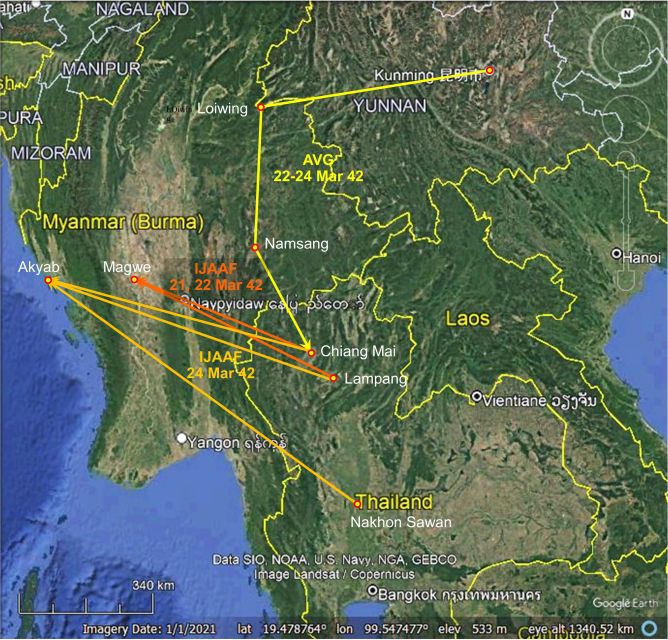
 24 March 1942:1 The Japanese had occupied Rangoon (Google Maps link) (present day Yangon) on 08 March 1942.2 From there they moved north in their quest to secure all of Burma with its mineral wealth. By 21 March, they had advanced 375 km north to attack Magwe,3 (Google Maps link) where 15 RAF Hurricanes (offsite link) and six Flying Tigers P-40s (offsite link) were based. Using 64th Sentai Ki-43 Hayabusas (offsite link) from Chiang Mai and Ki-21 bombers from the 12th Sentai in Lampang and the 98th Sentai in Nakhon Sawan, the IJAAF followed with a second attack forcing Royal Air Force and Flying Tiger contingents to evacuate Magwe early on 23 March. Reports that the attackers had probably included fighters from Chiang Mai4 (Google Maps link) and bombers from Lampang5 (Google Maps link) decided Flying Tiger Commander Claire Lee Chennault (offsite link) to order a retaliatory attack on those two Thai airfields. On 22 March, two Flying Tiger squadrons flew in stages, from Kunming’s Wujiaba airfield6 (Google Maps link) to overnight in Loiwing7 (Google Maps link), to Namsang8 (Google Maps link) where they again overnighted, to take off the next morn to attack the Chiang Mai and Lampang airfields. In that attack, the squadrons lost two aces: John Newkirk, killed in a crash, and William McGarry, who parachuted from his AA-damaged P-40 to be captured; plus neither squadron reached the second target, Lampang.
While much attention is paid to the loss of two Flying Tiger aces, less is focused on the result of the attack on the target, Chiang Mai airfield, which involved extensive destruction as described by Senshi Sosho and especially well documented by Umemoto.
References:9
- Senshi Sosho 34:10
pp 702-703
同日午後の第四撃は第七、第十二両飛行団が協同進攻 した。第七飛行団は飛行第六十四戦隊(一八機)、第十二 戦隊(ニ七機— I00瓧六、五〇瓱ニ四六)、第九十八戦隊(ニ六機—五〇§二ニ発)を、第十二飛行団は二三機を出動 させ、全機無事帰還した。 。 。 。
。 。 。 翌二十四日、第七飛行団は、この日午後のアキャブ進攻に備え、チエンマイの飛行第六十四戦隊では朝から休養をしていた。この時、戦隊はP—40六機の対地銃撃を受けチエンマイの高射砲は直ちに射撃してニ機撃墜を報じたが、地上の一式戦は一瞬にして炎上三、破壊十数機の損害を受けた。撃墜機の操縦者一名を捕虜とした。彼は第七飛行団司令部所在のランパン攻撃の命を受けて昆明を出発したがランプーン飛行場を誤つて攻撃し、帰路その一部がチエンマイを襲つたものであり、米国義勇飛行隊員であつた。 。 。 。
。 。 。 午後、第七飛行団は飛行第十二戦隊(ランパン二七機)、第九十八戦隊(ナコンサヮンニ六機)および一式戦(チエンマイ一一機)をもつてアキャブ飛行場に進攻し、飛行場を制圧して帰還した。
Translated:
[22 March 1942] The fourth attack that afternoon was a joint offensive by the 7th and 12th Air Groups. The 7th deployed the 64th Sentai (18 aircraft), the 12th Sentai (27 aircraft), and the 98th Sentai (26 aircraft), while the 12th dispatched 23 aircraft. All returned safely. . . .
. . . [On] the 24th, the 7th Air Group prepared for an attack on Akyab11 (Google Maps link) in the afternoon. The 64th Sentai had been resting in Chiang Mai since morning. At some point, the sentai, parked on the field, was strafed by six P-40s. Chiang Mai’s anti-aircraft guns immediately fired and reported shooting down two aircraft, but three Hayabusas (Ki-43s) on the ground immediately burned with more than a dozen total aircraft damaged. One pilot who had been shot down was taken prisoner. They had departed Kunming to attack the 7th Squadron Command at Lampang, but mistakenly attacked Lamphun Airfield12 (Google Maps link), and then attacked Chiang Mai on their way back. They were part of the US AVG [American Volunteer Group, aka, the Flying Tigers] Squadron. . . .
. . . In the afternoon, the 7th Air Group, with 27 aircraft from the 12th Sentai in Lampang, 26 aircraft from the 98th Sentai in Nakhon Sawan, and 11 Ki-43 fighters from Chiang Mai, advanced on Akyab Airfield, successfully attacked the airfield, and returned.13
[Key items: Senshi Sosho correctly identified Lampang as having been an AVG target, not Lamphun, but failed to include Chiang Mai. It does not mention the IJAAF having a captured Hurricane. It is not clear if the three Hayabusas burned were included in, or in addition to, the more than a dozen which were damaged: with a resulting total, 12 or 15; I assume the former. The quantity of 11 was given for the number of fighters acting as escorts for the subsequent IJAAF attack on Akyab.]
- Umemoto:14
Umemoto lists three IJAAF losses, identical aircraft, as burned:
p 461, lines 7, 8, 9
| Item | Japanese | English15 |
| Date | 3月24日 | 03 Mar 1942 |
| Unit | 64 | 64th Sentai |
| Aircraft lost | 一式戦l型 | Ki-43 (Hayabusa) |
| Pilot | 不明 | Unknown |
| Location | チエンマイ飛行場 | Chiang Mai Airstrip |
| Shooter | 2Sqn/AVG・P-40Bの対地攻撃 | AVG / 2Sqn / P-40B ground attack |
| Details | 地上で炎上 | Burned on the ground |
And then lists nine more IJAAF losses, identical aircraft, as wrecked:
p 461, lines 10 through 18:
| Item | Japanese | English |
| Date | 3月24日 | 03 Mar 1942 |
| Unit | 64 | 64th Sentai |
| Aircraft lost | 一式戦l型 | Ki-43 (Hayabusa) |
| Pilot | 不明 | Unknown |
| Location | チエンマイ飛行場 | Chiang Mai Airstrip |
| Shooter | 2Sqn/AVG・P-40Bの対地攻撃 | AVG / 2Sqn / P-40B ground attack |
| Details | 地上で大破 | Severely damaged on the ground |
And, finally, in addition, is a listing for a rogue aircraft:
p 461, line 19:
| Item | Japanese | English |
| Date | 3月24日 | 03 Mar 1942 |
| Unit | 64 | 64th Sentai |
| Aircraft lost | 鹵獲ハリケーンIIB | Prize of War Hurricane IIB |
| Pilot | 不明 | Unknown |
| Location | チエンマイ飛行場 | Chiang Mai Airstrip |
| Shooter | 2Sqn/AVG・P-40Bの対地攻撃 | AVG / 2Sqn / P-40B ground attack |
| Details | 地上で損傷•飛行不能 | Damaged on ground • Unable to fly |
pp 93-95:
「不死身のジャック」64戦隊の屈辱、チェンマィ空襲
3月24日、米義勇航空群のP40はタィ領内、ランパン飛行場の日本軍重爆隊を地上掃射で燃やすために、弾倉に焼夷実包を満載して離陸した。しかし第2飛行隊「パンダ•ベアーズ」のP40は目標を間違 い、64戦隊のー式戦が翼を休めていたチェンマイ飛行場を襲撃、2機を上空掩護に残し、4機が地上掃 射を行い、一式戦3機を炎上させ、10機あまりを損傷させた。また64戦隊の整備班がパレンバンで整備 補修して飛行可能にし、加藤中佐と、安間大尉の操縦で、はるばるチェンマイまで持ってきたハリヶー ン(日の丸を描き、尾翼には白い矢印が入っていた)もエンジンに被弾、結局、捕獲ハリヶーンで連合 軍飛行場を奇襲するといぅ加藤戦隊長の腹案は実現しなかった。
この日、64戦隊では、午後に予定されていたアキャブ攻撃準備のため、午前中は整備に当てられてい た。飛行場では、警急当番の第3中隊、安間大尉、武村中尉、安田曹長、平野軍曹が待機していただけ であった。攻撃が始まったとき、かれら4人は一式戦に向かって駆けだしたが、激しい地上掃射を受け、 窪地に伏せたまま動けなくなった。一方、整備兵たちは、銃撃の中を駆け、隼のプロペラを回した。だ が、結局、離陸することはできなかった。
しかし、日本軍高射機関砲の反撃で「パンダ.ベアーズ」の飛行隊長ジャック.ニュー力ーク機が火 だるまとなり墜落、「不死身のジャック」は戦死。マック•マクギャリー機も損傷し、帰途、落下傘降 下した。 。 。 。
大きな損害は受けたものの、64戦隊には未だ11機の可動ー式戦がぁり、この午後、12戦隊の九七重爆 27機、98戦隊九七重爆26機とともにァキャブ飛行場に進攻した。 。 。 。
Translation:
“Immortal Jack”, 64th Sentai humiliation, Chiang Mai air raid
On March 24, P-40s of the US AVG were dispatched from Kunming to strafe Japanese heavy bombers at Lampang Airfield in Thailand.
Magazines were full of incendiary cartridges when they took off.16 However, the P‑40s of the 2nd Squadron, “Panda Bears”, made a mistake in the target, and attacked Chiang Mai Airfield where the 64th Sentai was resting. The P-40s kept two aircraft high in the sky for protection while four aircraft strafed near ground level, burning three 64th Sentai aircraft and damaging about 10 other aircraft. Unknown to the AVG, the 64th Sentai had repaired and was maintaining a Hurricane captured in Palembang17 [Google Maps link] in the then Dutch East Indies. Lt Col Kato [offsite link] and Capt Yasuma had flown it to Chiang Mai. It had a Hinomaru, a Japanese flag, painted on it, with a white arrow on the tail. However, the 2nd Squadron strafing hit the engine, and Kato’s plan to surprise the Allied Airfield with a captured Hurricane did not come to pass.
On this morning, Sentai 64 personnel were busy maintaining aircraft in preparation for an attack on Akyab, scheduled in the afternoon. At the airfield, the 3rd Chutai was on duty, with Capt Yasuda, Lt Takemura, Master Sgt Yasuda, and Sgt Hirano standing by. When the attack began, the four of them rushed for their aircraft, but were forced to shelter in a depression to avoid the intense ground strafing. Nonetheless, the mechanics ran through the shooting to turn propellers for starting engines; but in the end, they couldn’t take off.
A Japanese anti-aircraft gun brought down the Squadron’s flight captain, “Immortal Jack” Newkirk of the “Panda Bears”, and he was killed in the crash. “Mac” McGarry’s aircraft was also damaged, and, on his way home, he parachuted out to be captured by a Thai police officer and handed over to the Japanese army. . . .
Despite heavy damage that day, the 64th Sentai was still able to field 11 Ki-43s, and, in the afternoon, with these they advanced to the Akyab airfield escorting 27 Ki-21s of the 12th Sentai and 26 Ki-21s of the 98th Sentai. . . .
[Key details: Umemoto provides some of the best details of IJAAF activities. His precise listing of damaged IJAAF aircraft at Chiang Mai is invaluable. His grasp of Allied activities is not so reliable. He does not mention the 1st Squadron, the ‘Adam and Eves’, which was, in fact, assigned Chiang Mai as a target and was responsible for almost all the destruction at Chiang Mai. He presented Chiang Mai as having been a target by accident, with only Lampang originally intended: the 2nd Squadron’s target was actually Lampang, which it never reached. His listing totals thirteen aircraft; twelve are Ki‑43s. Similar to Senshi Sosho, he notes in his text, “more than a dozen total aircraft damaged”. But in having individually named twelve affected Ki-43s, the “more than” must have been the thirteenth that he listed, the “Prize of War Hurricane IIB” that Kato had brought in from the Dutch East Indies. John Newkirk’s demise was less likely due to AA fire, or any ground fire, but more likely to have been his colliding with a tree during a low level firing run.18 The quantity of 11 was given for the number of fighters acting as escorts for the subsequent IJAAF attack on Akyab and he identifies them all as Ki-43s.]
- Shores, et al:
p 347:
JAAF Order of Battle, Burma Theatre of Operations, 20 March 1942
Fighters . . . 64th Sentai Chiang Mai 15 Ki 43s, 2 Ki 27s (plus 1 Hurricane captured in Malaya)
p 355:
[22 March 1942, Sometime after 1300, at Magwe,] a further attack . . . followed . . . comprised [of] 27 Ki 21s of the 12th Sentai, 26 of the 98th, 18 Ki 43s of the 64th Sentai . . . .
pp 356-357:
[24 March 1942] Early next morning . . . the ‘Adam and Eves’ [1st Squadron] flew on to their targets alone. This was Chiangmai airfield in Thailand, where an estimated 50 aircraft were seen on the ground. . . . the P‑40s dived through heavy AA fire, made several passes and claimed 13 aircraft destroyed, all of which were identified as bombers. . . . Vice-Sqn Ldr [of 2nd Squadron] arrived while the 1st Squadron were still there, . . . shared in the destruction of one aircraft and claimed two more alone, bring the total claims to 15.
Despite these losses the 64th Sentai was still able to dispatch 11 fighters that afternoon, to escort 53 Ki 21s to undertake a repeat attack on Akyab. (Google Maps link).
[Key useful details: On the 20 March 1942 Order of Battle (OOB), the 64th Sentai had only 15 Ki-43s. By 22 March, it had 18 Ki-43s, so they were apparently being reinforced, and by 24 March, there were an estimated 50 aircraft seen at Chiang Mai airfield — more of which could be assumed to have been Ki-43s. The number of IJAAF aircraft destroyed claimed by the Flying Tigers was 15. The quantity of 11 was given for the number of fighters acting as escorts for the subsequent IJAAF attack on Akyab.]
- Ford (in his 1991 and 2007 editions):
p 240:
[22 March 1942] . . . [The IJAAF’s] second wave reached Magwe: fifty-three Sallys and eighteen Hayabusas from Thailand [from the 64th Sentai in Chiang Mai]. . . .
pp 244-245:
Charlie Bond described a line of parked aircraft as “sitting practically wingtip to wingtip”. . . . Seemed like the whole Japanese Air Force had tried to crowd into this one little field.”
On his last strafing run, Charlie Bond ‘concentrated on a larger plane that “seemed to shake itself to pieces” under his machine guns.’
Boyington “saw three transports burning in one great bonfire, the flames shooting a thousand feet into the air.”
Bob Neale estimated “that forty planes were on the field” and anti-aircraft fire was “the heaviest I have ever seen”.
Ford commented, p 246:
In truth, the 64th Sentai lost only three Hayabusas that morning, plus the werwolf19 Hurricane brought from the Indies. Ten more Hayabusas were damaged, but the Japanese mechanics were as industrious as their AVG counterparts, and by noon they had eleven planes fit to fly—only five fewer that the group had sent to Magwe on Saturday. Kato led this force 350 miles to the west coast of Burma, in support of fifty-three heavy bombers while they blitzed Akyab airport . . . .
Key items: The IJAAF’s earlier attack on Allied-held Magwe included 18 Huyabusas. Charlie Bond’s impression of the large number of aircraft on the Chiang Mai field was supported by Bob Neale’s estimate of 40 aircraft there. Charlie Bond’s description of a larger aircraft which he targeted on his last run could have been the rogue Hurricane. Boyington’s sighting of three transports burning had to have been the three Huyabusas that burned. Ford’s arithmetic about the 11 planes made ready for the attack on Akyab were only five fewer than the number, 18, that had attacked Magwe, was in error: 18-11=7, not 5.
Discussion:
The record is somewhat muddled as to, one, the intended targets of the AVG, two, the number of Ki-43s strafed and, three, details about one or two captured Hawker Hurricanes.
First, the targets set out by Chennault were airfields at Chiang Mai and Lampang, with the latter having been confused with its neighboring town, Lamphun, 65 km to the northwest. Lamphun airfield was actually much closer to Chiang Mai at only 20 km than it was to Lampang.
The total number of aircraft on the field were estimated at 40 (Ford) and 50 (Shores, et al). The question of the number of the total IJAAF aircraft damaged, Ki-43s and werewolf Hurricanes, could be seen as having been intertwined:
- Senshi Sosho tallied three Hayabusa on the ground immediately burned with more than a dozen total aircraft damaged: assuming the three burned are included in the total damaged, that’s 12.
- Umemoto tallied three 64th Sentai Ki-43s burned with nine more severely damaged, all on the ground, that is, none had been damaged in air combat. In addition, he noted a “Prize of War Hurricane IIB” had been disabled during the strafing. That’s 3 burned+9 severely damaged+1 disabled Hurricane=13.
With regard to the werewolf Hurricane, he wrote (in translation):
Unknown to the AVG, the 64th Sentai had repaired and was maintaining a Hurricane captured in Palembang. Lt Col Kato and Capt Yasuma had flown it to Chiang Mai. It had a Hinomaru, a Japanese flag, painted on it, with a white arrow on the tail. However, the 2nd Squadron strafing hit the engine, and Captain Kato’s plan to surprise the Allied Airfield with a captured Hurricane did not come to pass.
Note that in the Japanese language, a noun does not differentiate singular vs plural; hence, for example, the first sentence might also be translated as:
Unknown to the AVG, the 64th Sentai had repaired and was maintaining Hurricanes captured in Palembang. Lt Col Kato and Capt Yasuma had flown them to Chiang Mai. They had Hinomaru, a Japanese flag, painted on them, with white arrows on their tails.
Actually that rendering in the plural might better explain Umemoto’s identifying two pilots. On the other hand, he does list only one werewolf Hurricane as hit by strafing.
- Shores, et al, writing of IJAAF Ki-43s (p 357), stated that “Three of these went up in flames and at least ten others were damaged beyond repair”. Shores’ in his ten count, apparently unknowingly, included the rogue Hurricane that the Japanese had captured in the Dutch East Indies.
In the 20 March 1942 OOB, the 64th Sentai had 15 Ki-43s; by 22 March, the sentai had 18 Ki-43s. Obviously they were being supplemented. The 3 Ki-43s burned plus the 10 that were damaged beyond repair totaled 13. 18 total count-13 destroyed=5 unscathed. To make up the 11 that attacked Akyab that afternoon, 6 of the “destroyed” Ki-43s had to have been resurrected to add to the 5 unscathed. But, more likely, by 24 March, there were enough more Ki-43s among the estimated 40 or 50 reported on the airfield to provide the 6 needed. - Ford provides information on Allied activities that appears more detailed and accurate than Shores, et al, presumably because of his access to US records and his being able to concentrate on a much smaller time period; with lesser access to IJAAF records and probably some of that destroyed, he provides fewer details about the IJAAF. Writing in his 2007 edition:20
In truth, the 64th Sentai lost only three Hayabusas that morning, plus the werwolf Hurricane brought from the Indies. Ten more Hayabusas were damaged, but Japanese mechanics were as industrious as their AVG counterparts, and by noon they had eleven planes fit to fly.”
That was Ford’s understanding in 2007:21 3 burned+1 Hurricane disabled+10 damaged=14.
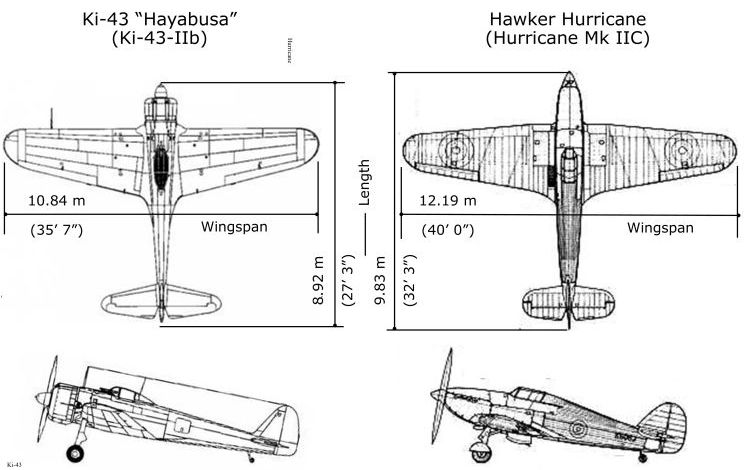
On his last strafing run, Bond’s concentrated on ‘a larger plane that “seemed to shake itself to pieces” under his machine guns’. He didn’t identify it as a transport. Quite possibly it was the werewolf Hurricane. Hurricanes were definitely larger than the Ki-43s:22
In 2014,23 Ford raised the werewolf Hurricane count to two:
On January 16, Major Kato and his men were diverted to Sumatra in the Dutch East Indies. . . . At Palembang airfield, the group found two comparatively undamaged Hurricane fighters and managed to put them in shape for flying. . . . After Rangoon was captured on March 8, the 64th Sentai was ordered back to the mainland. Its new base was at Chiang Mai in northern Thailand, due east of the AVG’s former airbase at Toungoo. The Hurricanes came along . . . The intention was to use the Hurricanes in “werewolf” attacks on British airfields, since their . . . appearance would allow them to get in close before raising an alarm.
So it happened that the werewolf Hurricanes were sitting on the ground at Chiang Mai on the morning of March 24, when the AVG Tomahawks swept across in their vengeance raid, ordered by Chennault to retaliate for the Allied disaster at Magwe. When the AVG pilots claimed fifteen Japanese aircraft destroyed at Magwe . . . two of them were the former RAF Hurricanes. No more was heard of the werewolves . . . .
So, hypothesizing, Ford’s count of 15 was now composed of 3 Ki-43s burned+2 Hurricanes+10 Ki-43s damaged=15 total (though Umemoto lists only one Hurricane damaged).
Thus the IJAAF aircraft damaged count lies between Senshi Sosho and Shores, et al’s 12 and Ford’s 15. And the rogue Hurricanes count is either one or two.
| First published on Internet | ||
| Updated | ||
Last Updated on 7 September 2026
- Map extracted from Google Earth and annotated with Microsoft Publisher by author; note that for IJAAF flights, the lines connect only origins and destinations of flights. In actual fact, for the IJAAF attacks on Magwe (N20°09.27 E94°58.15) and Akyab, (N20°07.96 E92°52.30) (both Google Maps links) aircraft were funneled through Chiang Mai, where the “armadas” were assembled to then proceed to their targets.[↩]
- The Fall of Rangoon (offsite link) [↩]
- N20°09.27 E94°58.15[↩]
- N18°46.30 E98°57.80[↩]
- N18°16.33 E99°30.24[↩]
- N24°59.53 E102°44.60[↩]
- N23°53.91 E97°37.37[↩]
- N20°53.4 E97°44.1[↩]
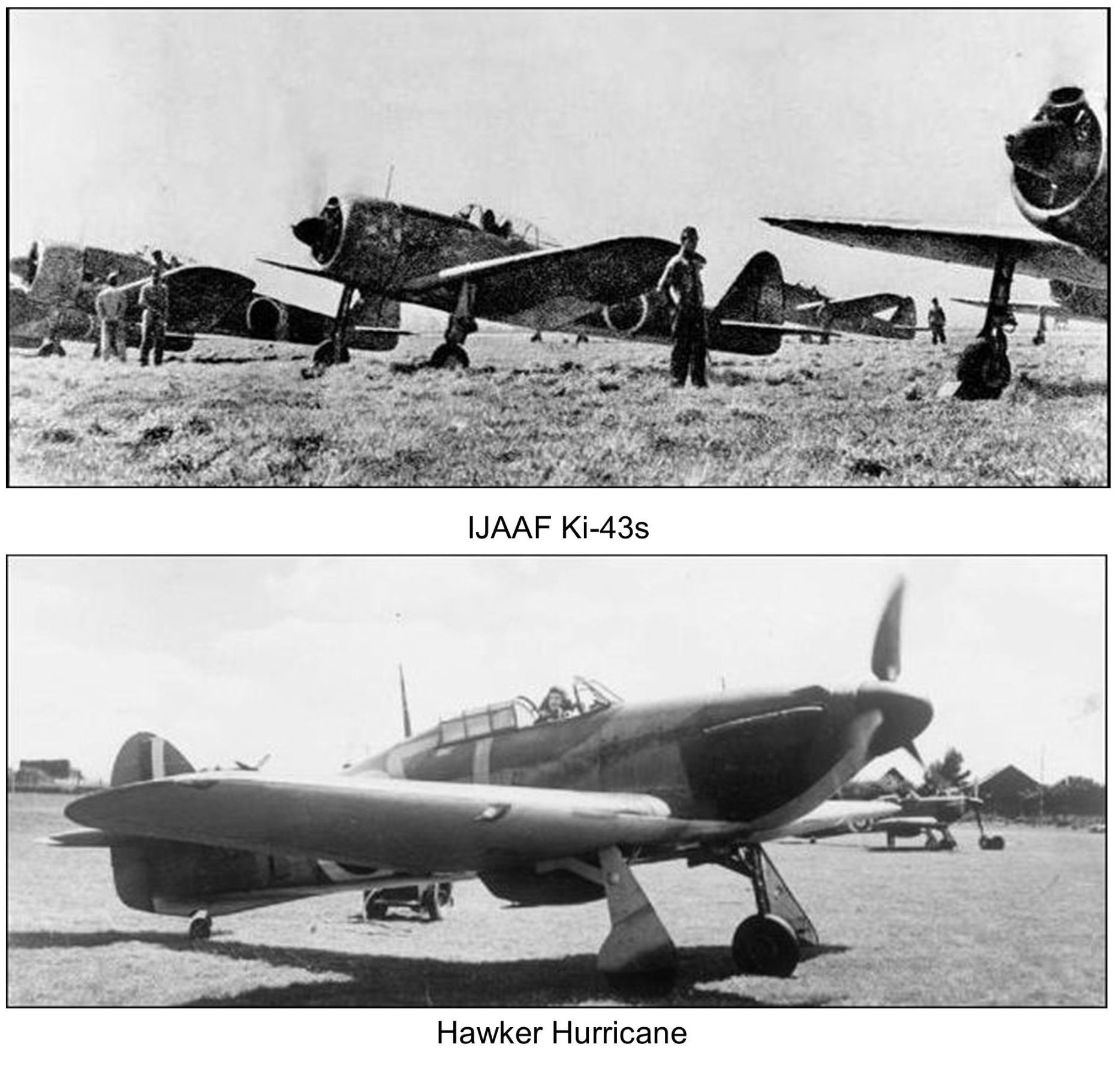
- Photos: Ki-43s: Warfare History Network WWII Aircraft: Nakajima Ki-43 https://warfarehistorynetwork.com/wp-content/uploads/Nakajima-Ki-43-Oscar-Nr-015.jpg: my ref: \02500 Tango\_Crash sites N TH for Tango\DETAIL SHEETS\J420324 Chiang Mai [J09A]\Ki-43 in rows.jpg; and WW2 Wings of Glory – Battle of Britain: Hawker Hurricane Mk.I https://www.aresgames.eu/18574, Hurricane my ref: \02500 Tango\_Crash sites N TH for Tango\DETAIL SHEETS\J420324 Chiang Mai [J09A]\Hurricane rev.jpg[↩]
- 戦史叢書, 南方進攻陸軍航空作戦, Vol 34
(東京: 防衛庁防衛研修所戦史室 (編集), 1970年)
Senshi Sosho, Southern Army Air Operations, vol 34
(Tokyo: Asagumo Shimbunsha, 1970) [↩] - N20°07.96 E92°52.30[↩]
- N18°34.06 E99°02.48[↩]
- The British garrison at Akyab eventually withdrew on 04 May 1942. (The Pacific War Online Encyclopedia (offsite link) ) [↩]
- 梅本弘,ビルマ航空戦・上 (東京:大日本印刷株, 2002) [Umemoto, Hiroshi, Air War in Burma, vol 1 (Tokyo: Dai Nippon, 2002)] hereafter, Umemoto[↩]
- Google translation (typical) [↩]
- An odd detail: this sentence is curiously similar to one in Ford: “Their ammunition boxes heavily laden with incendiary rounds, the Tomahawks took off from Wujiaba . . . .” (p 241), but the Umemoto text is a translation.[↩]
- S02°53.690 E104°42.28[↩]
- See Jack Newkirk, the view from the ground (offsite link).[↩]
- the German spelling for werewolf — Ford reverted to the English spelling in his Rising Sun over Burma[↩]
- p 246; presumably he wrote the same in his original 1991 edition which I don’t have.[↩]
- p 246[↩]
- The Ki-43 outline is from Ki-43 “Blueprint” (offsite link); the Hurricane outline is from The Hawker Hurricane (offsite link); the author used Microsoft Publisher to assemble and annotate the illustration[↩]
- Rising Sun Over Burma: Flying Tigers and Wild Eagles, 1941-1942, Kindle edition, unpaginated[↩]