Introduction
A lone reference tells of a Dane employed by the Thai government and living in Chiang Rai1 (Google Maps link) at the beginning of WW2 who was apparently allowed to remain free and continue working during the war:2
Bertel Thorvaldsen . . . worked as a colonel in the Thai Border Police under the Japanese occupation in World War II.
This situation seemed sufficiently unusual to justify research, and the results are provided below.
Background
King Chulalongkorn ruled Siam (Thailand) 1868 to 1910 and his reign is noted for, amongst other things, simplification of government organization with major reforms to its administration, including the standardization of law enforcement into a kingdom-wide gendarmerie.3
Both King Chulalongkorn and his half-brother, Prince Damrong, had visited Denmark (Google Maps link) in the 1890s and presumably were impressed with its so-called Blue Gendarmerie,4 which existed 1885–1894 to assist the Danish police in domestic security matters; and the concept was adopted by Siam’s Ministry of Interior in 1897.5
From Wright in 1908 (emphasis added):6
Outside the capital and the surrounding province the country is policed by the gendarmerie . . . There are no less than 345 stations scattered over the country, which serve as centres for the prevention and suppression of crime. . . . The work of administration is carried on by Siamese officers, who are assisted, at the present time, by thirteen Danish officers, as inspectors and instructors, stationed in the different circles according to the exigencies of the service.
The gendarmerie evolved in several integrations with other law enforcement units to eventually become today’s Royal Thai Police (RTP).7 Under the umbrella of the RTP, the Border Patrol Police was established in 1951.8

Bertel Thorvaldsen 1875-195710 11
Ten Danish army officers were initially recruited to assist the gendarmerie, one of them being Bertel Thorvaldsen, who arrived in Thailand in 1901, aged 26. Except for a two-year return to Denmark (1914-1916), Thorvaldsen served continuously in the gendarmerie until it was disbanded in 1926 because of economic difficulties in the kingdom. Early in his career in Thailand, he married a Thai of noble birth from Chiang Mai and eventually fathered ten children, the last born in 1932.12 Effectively retired at age 51, but with a generous Thai government pension, he elected to remain in Thailand, settling in Chiang Rai where he had spent much of his career, and became involved in various pursuits, including a hotel, a tobacco farm, a 225 km bus service linking Chiang Rai and Lampang (Google Maps link), an equipment parts shop, and a lumber mill.
Thorvaldsen’s success in business was matched by his seeing all ten children through university, with two winning major scholarships enabling study overseas. (Find A Grave: Dr Dana Thornagkul Lee (offsite link) and Find a Grave: Thora Purdom (offsite link).))
In 1942, with WW2 impacting Thailand, foreigners were imprisoned under orders of the Japanese and a Thorvaldsen family history records that Chiang Rai officials successfully pled with IJA officials for Thorvaldsen’s freedom, citing his long service to Thailand. However, while granting his freedom, IJA officials required that he leave Chiang Rai. How much of this is accurate, however, is puzzling, for ScandAsia (offsite link) notes (emphasis added):
During the Second World War, the Danes in Siam were not rounded up and imprisoned by the Japanese along with the British and Dutch foreigners. Because of the German occupation of Denmark on 9 April 1940 and as the Germans were allied with the Japanese, the Danes were considered to be friendly along with the German foreigners in Siam at the time.13
In addition, the Japanese might have observed that Denmark had not participated in colonizing Southeast Asia, which had earned Japan’s ire for Britain, France, and the Netherlands.14 A fuller perspective on this situation is offered in ScandAsia’s article in Danish and WAR Wood’s petition for compensation following the war (see below).
Nonetheless, Thorvaldsen, aged 66, was recorded as relocating to Bangkok where he rented a house for the duration of the war. In the absence of its patriarch, the family carried on: the family history recalls that the eldest son, Alexander, in his 30s by that time, was active in the local Seri Thai and agreed to maintain a waystation for Seri Thai personnel coming into northwest Thailand by parachute or on foot from Kunming, China (Google Maps link). He (or possibly someone else) locally maintained radio communication with Allied forces in Kunming and the IJA eventually intercepted a wireless message which resulted in the IJA searching the Thorvaldsen house. While two of the children were terrified by the appearance of IJA soldiers at their door, an older daughter present, Christina, maintained her poise, sent a warning to Alexander at their tobacco farm where Seri Thai personnel were in hiding, and then welcomed the IJA in to successfully allay their suspicions. But the IJA did continue on to the tobacco farm, where Alexander succeeded in passing off the Seri Thai as ordinary farm employees.15
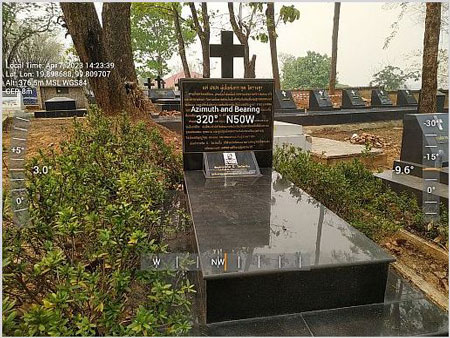 Thorvaldsen died in 1957 of cancer. He is buried in Nong Hiang Christian Cemetery (Google Maps link).16
The inscription beneath the photo,
ผู่ริเริ่มนำความเจริญมาสูวงการตำรวงภาคเหนือ
translates approximately,
The man who guided development of the Northern Region police force
Conclusions
The introductory statement taken from an obituary that told of Bertol Thorvaldsen / Thornagkul having worked in the Thai Border Police during WWII is not true. As noted, by the beginning of the war, he had been retired from government service for 16 years. Further, the Thai Border Police (Border Patrol Police) unit of the RTP was only established in 1951, well after the end of the war.
If Thorvaldsen was in fact not detained during the war as told in the family history, his freedom was perhaps unique amongst all nominally Western foreigners present in Thailand at the beginning of the war. His family history attributes his freedom to intercession by Chiang Rai officials on his behalf and the IJA honoring their request.
There is also a possibility that his Danish citizenship figured in a Japanese leniency towards him: since Denmark had been occupied by Germany in 1940, Denmark might have been considered an ally of Germany, which in turn was an ally of Japan, which in turn was an ally of Thailand. So, Thorvaldsen, a Dane, was a citizen of an ally of Japan. The same logic would have applied to the Japanese relationship with French civilians in Vichy French Indochina during most of WW2.17
However, if, as the book states, the IJA merely banished Thorvaldsen from Chiang Rai, and apparently gave him a choice as to where else to live, it seems peculiar that he would have chosen to live as far away as Bangkok. Alternatives appear to have been Chiang Mai where he had numerous contacts with relatives of his wife, or Lamphun where his father-in-law resided. It is also possible that he was actually banished not just from Chiang Rai, but from northern Thailand altogether. Tangible evidence corroborating Thorvaldsen’s presence in Bangkok during the war and his circumstances there would provide support helpful to the family’s history.
Note of thanks
Special thanks to the following Thorvaldsen family members for their assistance, in order of our meeting with them:
- Krongjit Thadadet, who met us at the Work@Home Cafe, and provided much family information, and gave us additional contacts.
- Thorvald Thoravaldsen, who promptly provided us a copy of the book on the Thorvaldsen family history.
- Tawanchai Feungwatanapanit, who was the main source to the author of the family history book, and who provided additional details by Line phone calls about the family.
And to Bruce Kennedy who introduced us to key Thorvaldsen’s descendents.
Appendices
Two items are included below to broaden readers’ perspective on the experience of foreigners in Thailand during WW2: one on the functioning of the Danish community in Thailand during WW2, the other a petition from the British Consul in Chiang Mai for treatment seeking compensation for treatment believed unjust by the Thai government during the war.
1. Rapport vedrørende den danske Siam-kolonis forhold under Den anden Verdenskrig fra 9. april 1940 og indtil 1945
Original document written by Christian Frederik Schiopffe in 1955, but only published December 17, 2006 in ScandAsia by Gregers Møller; key items are here translated from Danish into English with Google Translate as: 18
Report on the conditions of the Danish colony of Siam during the Second World War from April 9, 1940 until 1945
Before Japan occupied Thailand
Immediately after the Germans occupied Denmark on April 9, 1940, practically all members of the Danish colony in Bangkok became ‘Visiting Members’ of the “British Club”, a club there that had previously only admitted English citizens.
Doing this was a gesture, knowing that the Danish colony, which at the time consisted of 105 male members, was practically all loyal to the Allies, or as an Englishman in one of the local newspapers later put it: “you are just one of us”.
By the above-mentioned favor, we were spared from meeting with the Germans in the international clubs, including Royal Bangkok Sports Club and Bangkok Riding and Polo Club. These clubs had previously been the daily meeting places for the members of the foreign colony for a number of years. . . .
After the occupation of Siam
When Japanese troops occupied Bangkok and, at about the same time, all Siamese provinces on December 2, 1941, the situation in the Danish colony became difficult.
American, English and Dutch citizens were arrested by the Japanese, but the Siamese demanded that future internment take place under Siamese control, which probably saved many lives.
The internment camp, which came under civilian Siamese administration, was set up in some older government buildings near the old palace, and those foreigners interned there were far safer throughout the occupation than we who were outside, as we were always shadowed by the Japanese secret police. Furthermore, immediately after the end of the war they received full compensation for all losses suffered; while the rest of us have not yet received this. . . .
The Danish colony was from the beginning of the occupation the largest of the free colonies out there. . . .
In early 1942, English and Dutch prisoners of war from the Dutch East Indies, Malaya and the Straits Settlements were sent to work as slave labor on the Burma-Siam Railway and to Japanese prison camps in Siam, of which the Kanburi camp became the most notorious.
Relief work
Relief work was difficult. There was a death penalty for helping the prisoners of war on “The Burma-Siam Railway” and in the prisoner of war camps, and the risk was further increased by the fact that all work had to be carried out through locally known Chinese and Siamese, but there is no case known where these were betrayed . . . .
Kanburi Camp
A very small circle within the colony was in contact with the Danish prisoner of war, Sergeant GA Andersen (buried in Kanchanaburi), and through him medicine was delivered to the prisoners . . . .
Newsfeed
Bans on eavesdropping on foreign radio stations were not strictly enforced at first, but gradually became more and more stringent.
When total prohibition came, and when the light station was destroyed by English bombers, Messrs. J. Knudtzon and NA Landgren received BBC news every morning by wiretapping at Bangkok’s Siamese police chief, Luang Adun Adun, and this news, copied by Landgren, circulated within a narrow circle of the colony, after which these papers were immediately burned.
Every Sunday morning, a small circle gathered In the home of civil engineer J. Knudtzon in Klong Toi . . . throughout the occupation . . . . to share news.
The bombings
In total we had 145 American and British air raids on Bangkok, 49 of which were over the city center.
The Japanese secret police
I have no idea how many Danish citizens were summoned by them, but [two Danes] . . . were arrested for a time and probably repeatedly interrogated; my wife and I were both interrogated seven times and each time were threatened with the death penalty under different and strange pretexts.
A Japanese diplomat, Mr. Shibha, who was the brother of my doctor at the Bang Nara Rubber Estate in South Siam, an estate I managed for many years, must have protected us, and he confided in us in private that we were on the “black” list of both the Japanese and the Germans, but my wife and I kept quiet, so it was possible to avoid arrest, and he recommended that we visit the civilian internment camp at the palace as little as possible.
Other members of the colony have probably received similar inquiries, but I have no further information on this matter.
Mr. Shibha did not hide the fact that there was poor cooperation between diplomacy and the police, and that the police’s knowledge of English, Malay and Siamese was poor, which made all interrogations difficult, or in fact impossible.
May 5, 1945
With the liberation of Denmark, the situation for the Danes became even more difficult, especially after Denmark had severed diplomatic relations with Japan. The Japanese wanted to introduce much stricter measures against us, but the Siamese, whom the Japanese did not dare to ignore completely, used a policy of delay that helped us.
The Liberation
Just as the death penalty had been introduced for not handing over all radios and firearms within a certain and very short time limit, we were ordered by the Consulate General to report to the Lumbini police station, then the bomb fell on Hiroshima, and we were free.
During the last days at the police station, we were greatly helped by Prince Ajavadis Diskul, . . . who volunteered to the colony to, as he said, check that the interrogations were properly recorded, as it could mean life or death. . . . He also helped us in many other ways, for example, he stored my firearms.
In August 1945, four months after Denmark’s liberation, we were also free, but there was no excitement or joy at the moment; our nerves had been too strained for that. . . .
The colony’s victims during the occupation
In total, . . . 11 Danish citizens were killed or died as members of the colony in Japanese prison camps and prisons in Siam or at sea just before and during the occupation . . . . And to this it must be added that several compatriots lost very significant amounts through confiscation, forced sale and the like, for which in the decade since the liberation – compensation has not yet been paid. . . .
During the looting of “Lodge Str. John, 1072, SC” and “Royal Arch Chapter, 357, SC”, very significant values were also lost to several Danish members.
The return home
In my capacity as president (chairman) of the Danish colony during the occupation and at the liberation, after my return to Denmark, at the request of “Danish Cooperative”, Copenhagen, I obtained . . . reports regarding the efforts of the Danish ladies for the war-stricken allies and for the Dutch forces that occupied Bangkok after the liberation. . . .
Lieutenant Colonel PG Mantel . . . wrote. . . that the ladies did under very trying conditions the most unselfish work for the soldiers working on the Death Railway Line . . . ”
Ending
No other Danish community outside Denmark has had even remotely as dangerous and difficult circumstances to work and live under as those in the Japanese-occupied countries.
We in Siam had to be loyal to the more or less voluntarily occupied Siam, which had always shown us great Danish hospitality and unrestricted right to operate, but at the same time we had to not compromise our dignity as representatives of free Denmark, and the Siamese knew from the time before the country’s occupation that practically the entire Danish colony was friendly to the Allies. . . .
2. WAR Wood petition for reimbursement for expenses and compensation for hardship endured during the war.
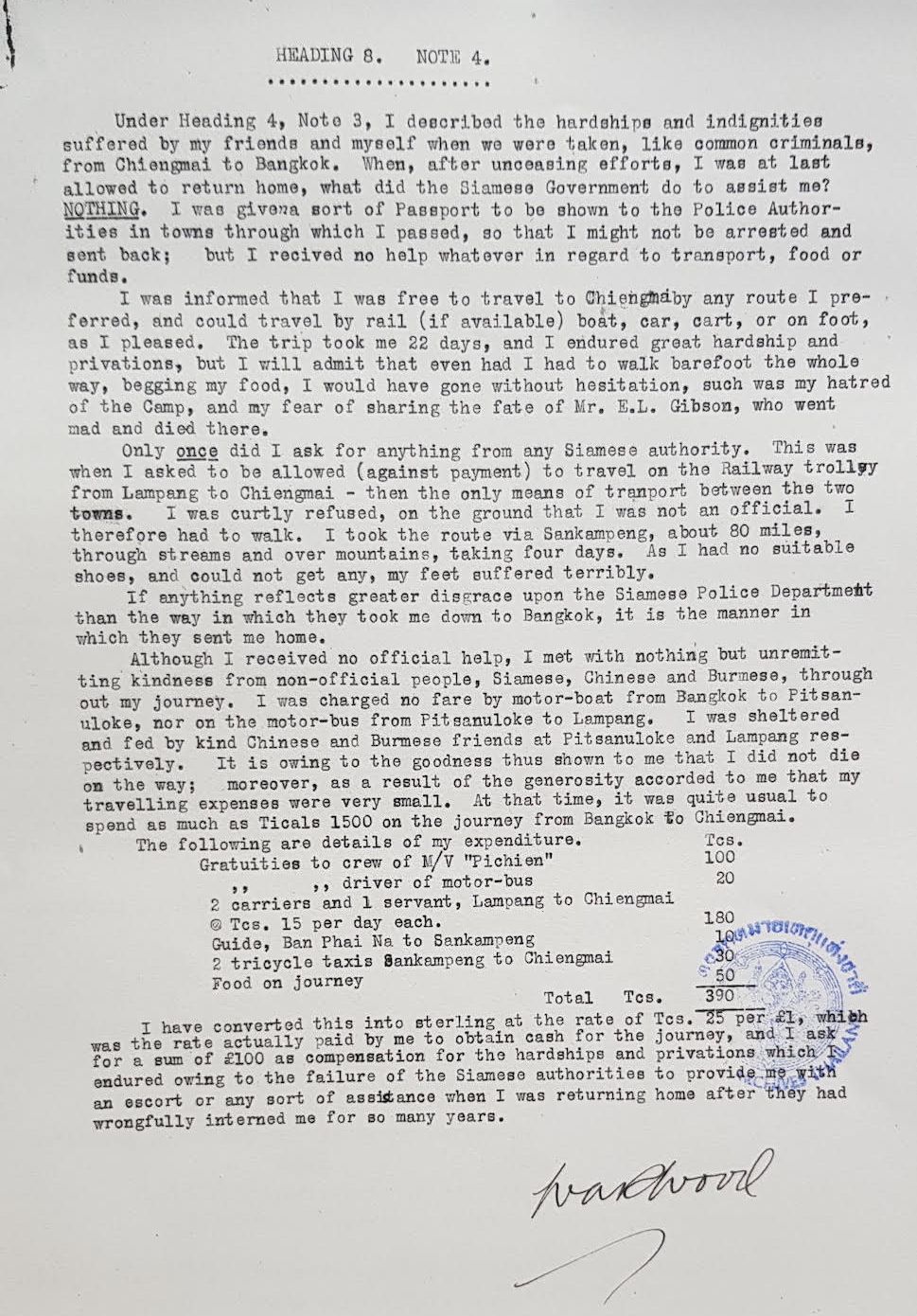
Wood, long retired British Consul in Chiang Mai19 made a post-war claim for unjust detention.20 The petition provides first hand observations of the difficulties that foreigners faced in detention in Thailand (transcripts follow the page images):
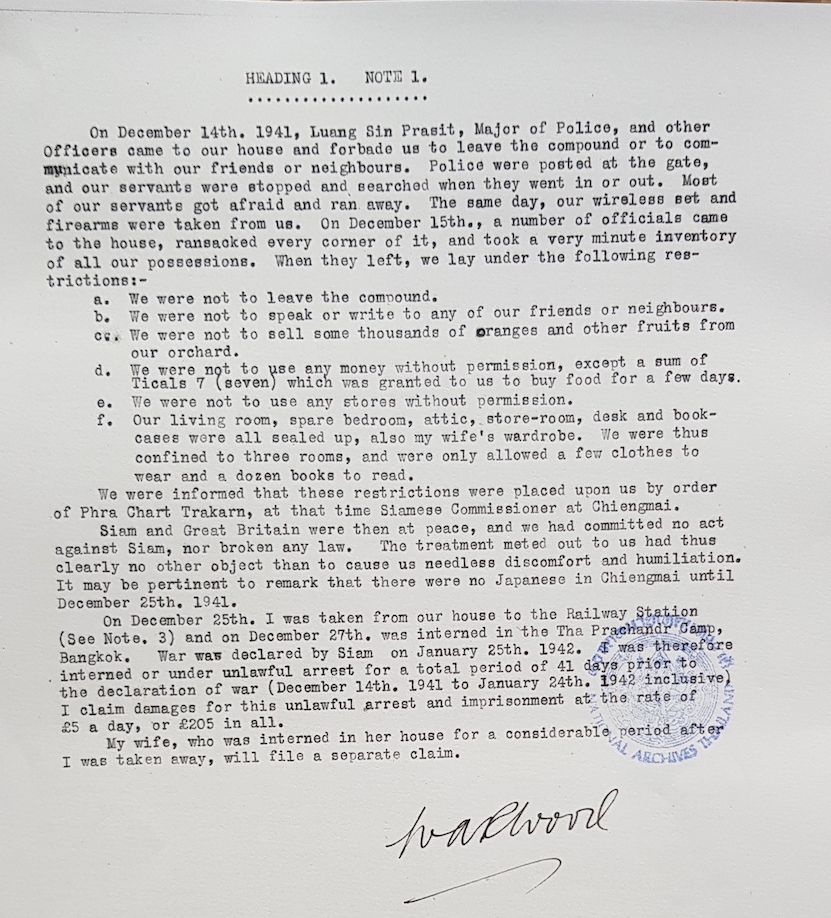
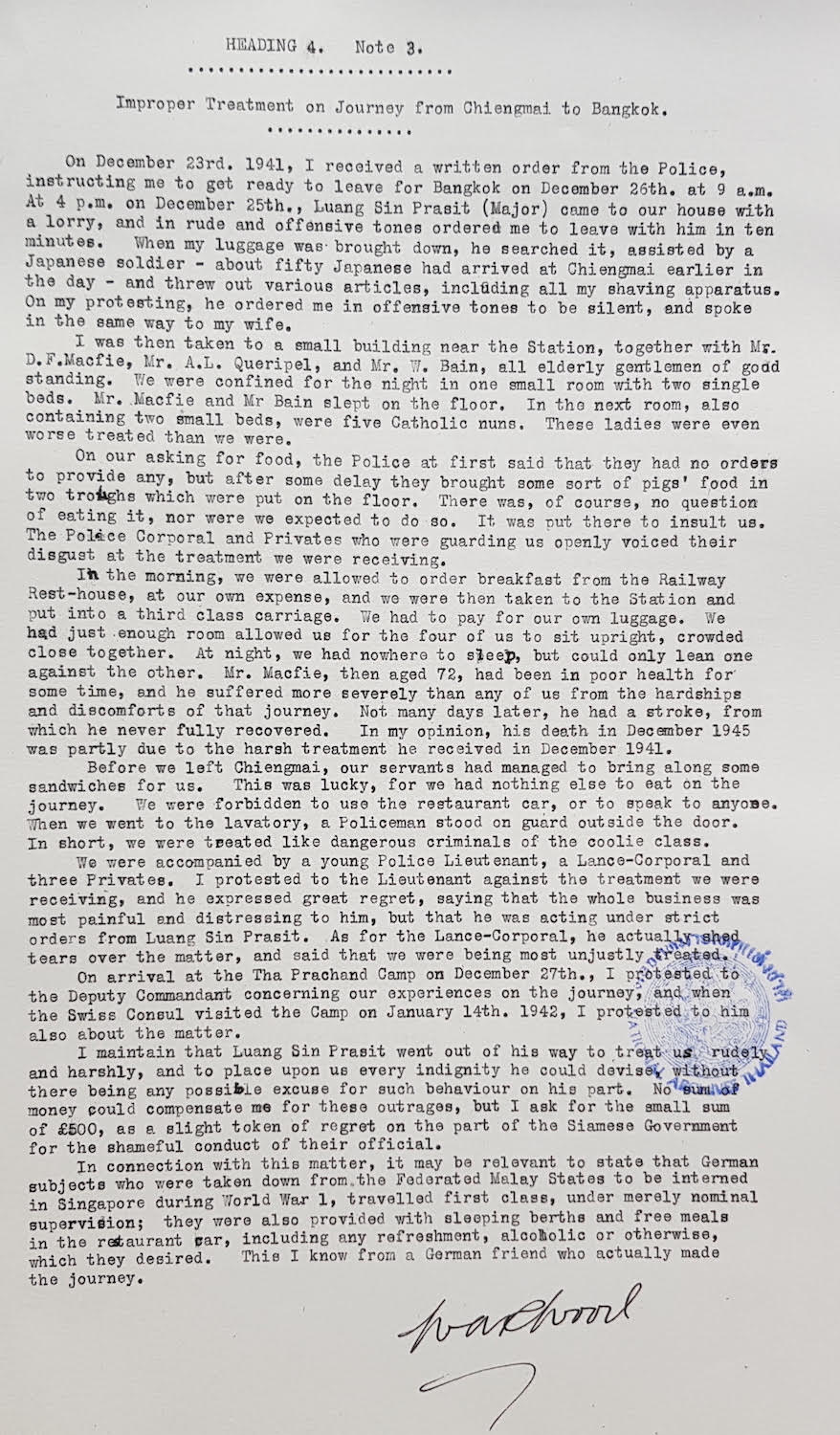
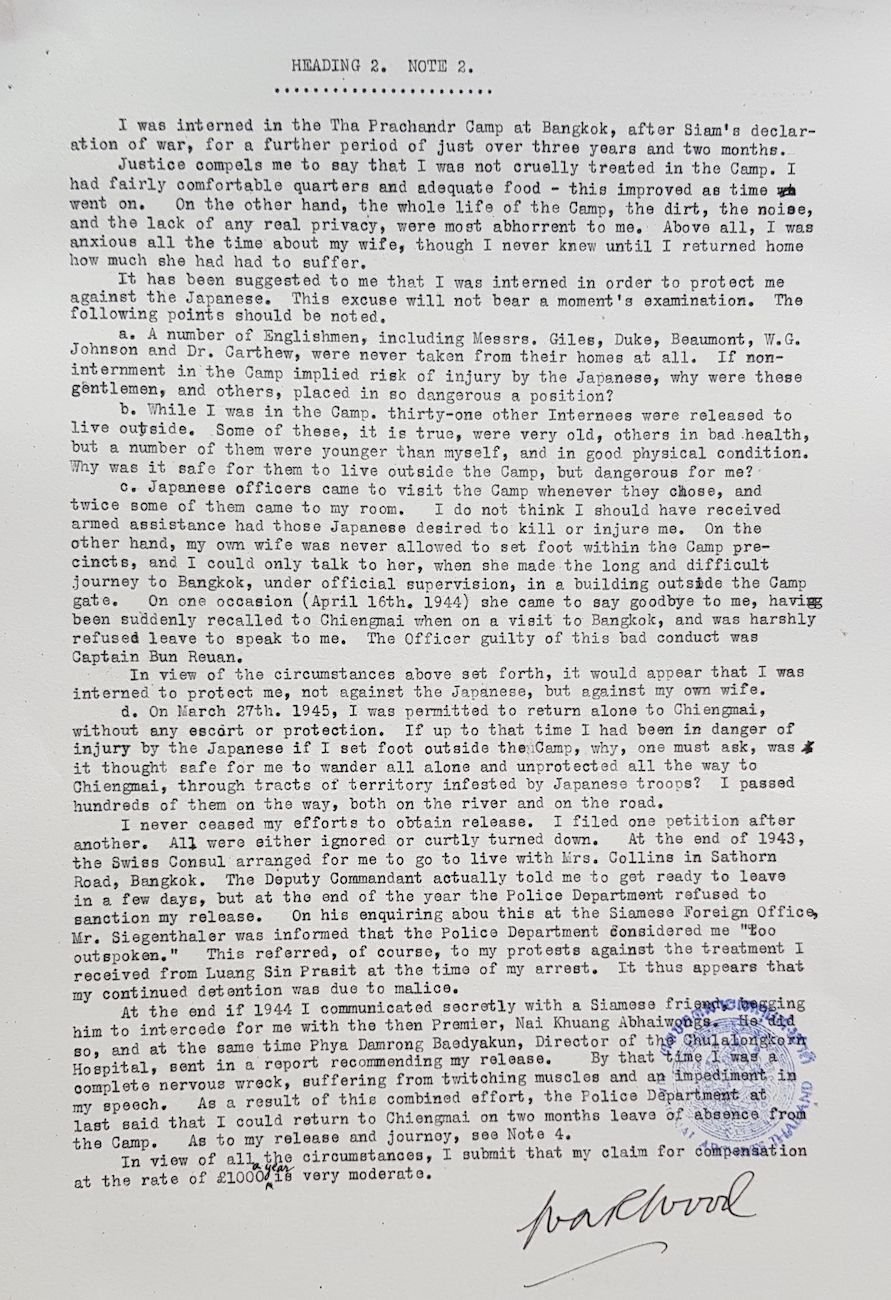
Transcripts of WAR Wood’s petition (above):
HEADING 1. NOTE 1.
On December 14th. 1941, Luang Sin Prasit, Major of Police, and other Officers came to our house and forbade us to leave the compound or to communicate with our friends or neighbours. Police were posted at the gate and our servants were stopped and searched when they sent in or out. Most of our servants got afraid and ran away. The same day, our wireless set and forearms were taken from us. On December 15th., a number of officials came to the house, ransacked every corner of it, and took a very minute inventory of all our possessions. When they left, we lay under the following restrictions:
a. We were not to leave the compound.
b. We were not to speak or write to any of our friends or neighbours.
c. We were not to sell some thousands of oranges and other fruits from our orchard.
d. We were not to use any money without permission, except a sum of Ticals 7 (seven) which was granted to us to buy food for a few days.
e. We were not to use any stores without permission.
f. Our living room, spare bedroom, attic, store-room, desk and bookcases were all sealed up, also my wife’s wardrobe. We were thus confined to three rooms, and were only allow a few clothes to wear and a dozen books to read.
We were informed that these restrictions were placed upon us by order of Phra Chart Trakarn, at the time Siamese Commissioner at Chiengmai.
Siam and Great Britain were then at peace, and we had committed no act against Siam, nor broken any law. The treatment meted out to us had thus clearly no other object than to cause us needless discomfort and humiliation. It may be pertinent to remark that there were no Japanese in Chiengmai until December 25th. 1941.
On December 25th. I was taken from our house to the Railway Station (See Note. 3) and on December 27th. was interned in the Tha Prachandr Camp, Bangkok. War was declared by Siam on January 25th. 1942. I was therefore interned or under unlawful arrest for a total period of 41 days prior to the declaration of war (December 14. 1941 to January 24th. !942 inclusive). I claim damages for this unlawful arrest and imprisonment at the rate of £5 a day, or £205 in all.
My wife, who was interned in her house for a considerable period after I was taken away, will file a separate claim.
WAR Wood
HEADING 4. Note 3.
Improper Treatment of Journey from Chiengmai to Bangkok.
On December 23rd. 1941, I received a written order from the Police, instructing me to get ready to leave for Bangkok on December 26th. At 9 a.m.. At 4 p.m. on 25th December., Luang Sin Prasit (Major) came to our house with a lorry, and in rude and offensive tones ordered me to leave with him in ten minutes. When my luggage was brought down, he searched it, assisted by a Japanese solder – about fifty Japanese had arrived at Chiengmai earlier in the day – and threw out various articles, including all my shaving apparatus. On my protesting, he ordered me in offensive tones to be silent, and spoke in the same way to my wife.
I was then taken to a small building near the Station, together with Mr. D.F. Macfie, Mr. A.L. Queripel, and Mr. W. Bain, all elderly gentlemen of good standing. We were confined for the night in one small room with two single beds. Mr. Macfie and Mr Bain slept on the floor. In the next room, also containing two small beds, were five Catholic nuns. These ladies were even worse treated than we were.
On our asking for food, the Police at first said that they had no orders to provide any, but after some delay they brought some sort of pigs’ food in two troughs which were put on the floor. There was, of course, no question of eating it, nor were we expected to do so. It was put there to insult us. The Police Corporal and Privates who were guarding us openly voiced disgust at the treatment we were receiving.
In the morning, we were allowed to order breakfast from the Railway Rest-house, at our own expense, and we were then taken to the Station and put into a third class carriage. We had to pay for our own luggage. We had just enough room allowed us for the four of us to sit upright, crowded close together. At night, we had nowhere to sleep, but could only lean one against the other. Mr. Macfie, then aged 72, had been in poor health for some time, and he suffered more severely than any of us from the hardships and discomforts of that journey. Not many days later, he had a stroke, from which he never fully recovered. In my opinion, his death in December 1945 was partly due to the harsh treatment he received in December 1941.
Before we left Chiengmai, our servants had managed to bring along some sandwiches for us. This was lucky, for we had nothing else to eat on the journey. We were forbidden to use the restaurant car, or to speak to anyone. When we went to the lavatory, a Policeman stood guard outside the door. In short, we were treated like dangerous criminals of the coolie class.
We were accompanied by a young Police Lieutenant, a Lance-Corporal and three Privates. I protested to the Lieutenant against the treatment were receiving, and he expressed great regret, saying that the whole business was most painful and distressing to him, but that he was acting under strict orders from Luang Sin Prasit. As for the Lance-Corporal, he actually shed tears over the matter, and said that we were being most unjustly treated.
On arrival at the Tha Prachand Camp on December 27th., I protested to the Deputy Commandant concerning our experiences on the journey, and when the Swiss Consul visited the Camp on January 14th. 1942, I protested to him also about the matter.
I maintain that Luang Sin Prasit went out of his way to treat us rudely and harshly, and to place upon us every indignity he could devise without there being any possible excuse for such behavior on his part. No sum of money could compensate me for these outrages, but I ask for the small sum of £500, as a slight token of regret on the part of the Siamese Government.
In connection with this matter, it may be relevant to state that German subjects who were taken down from the Federated Malay States to be interned in Singapore during World War 1, travelled first class, under merely nominal supervision; they were also provided with sleeping berths and free meals in the restaurant car, including any refreshment, alcoholic or otherwise, which they desired. This I know from a German friend who actually made the journey.
WAR Wood
HEADING 2. NOTE 2.
I was interned in the Tha Prachandr Camp at Bangkok, after Siam’s declaration, for a further period of just over three years and two months.
Justice compels me to say that I was not cruelly treated in the Camp. I had fairly comfortable quarters and adequate food – this improved as time went on. On the other hand, the whole life of the Camp, the dirt, the noise, and the lack of any real privacy, were most abhorrent to me. Above all, I was anxious all the time about my wife, though I never knew until I returned home how much she had had to suffer.
It has been suggested to me that I was interned in order to protect me against the Japanese. This excuse will not bear a moment’s examination. The following points should be noted:
a. A number of Englishmen, including Messrs. Giles, Duke, Beaumont, W.G. Johnson and Dr. Carthew, were never taken from their homes at all. If non-internment in the Camp implied risk of injury by the Japanese, why were these gentlemen, and others, placed in so dangerous a position?
b. While I was in the Camp, thirty-one other Internees were released to live outside. Some of these, it is true, were very old, others in bad health, but a number of them were younger than myself, and in good physical condition. Why was it safe for them to live outside the Camp, but dangerous for me?
c. Japanese officers came to visit the Camp whenever they chose, and twice some of them came to my room. I do not think I should have received armed assistance had those Japanese desired to kill or injure me. On the other hand, my own wife was never allowed to set foot the Camp precincts, and I could only talk to her, when she made the long and difficult journey to Bangkok, under official supervision, in a building outside the Camp gate. On one occasion (April 16th. 1944) she came to say goodbye to me, having been suddenly recalled to Chiengmai when on a visit to Bangkok, and was harshly refused leave to speak to me. The Officer of this bad conduct was Captain Bun Reuan.
In view of the circumstances above set forth, it would appear that I was interned to protect me, not against the Japanese, but against my own wife.
d. On March 27th. 1945, I was permitted to return alone to Chiengmai, without any escort or protection. If up to that time I had been in danger of injury by the Japanese if I set foot outside the Camp, why, one must ask, was it thought safe for me to wander all alone and unprotected all the way to Chiengmai, through tracts of territory infested by Japanese troops? I passed hundred of them on the way, both on the river and on the road.
I never ceased my efforts to obtain release. I filed one petition after another. All were either ignored or curtly turned down. At the end of 1943, the Swiss Consul arranged for me to go to liver with Mrs. Collins in Sathorn Road, Bangkok. The Deputy Commandant actually told me to get ready to leave in a few days, but at the end of the year the Police Department refused to sanction my release. On his enquiring about this at the Siamese Foreign Office, Mr Siegenthaler was informed that the Police Department considered me “too outspoken”. This referred, of course, to my protests against the treatment I received from Luang Sin Prasit at the time of my arrest. It thus appears that my continued detention was due to malice.
At the end of 1944 I communicated secretly with a Siamese friend begging him to intercede for me with the then Premier, Nai Khuang Abhaiwongs. He did so, and at the same time Phya Damrong Baedyakun, Director of the Chulalongkorn Hospital, sent in a report recommending my release. By that time I was a complete nervous wreck, suffering from twitching muscles and an impediment in my speech. As a result of this combined effort, the Police Department at last said that I could return to Chiengmai on two months leave of absence from the Camp. As to my release and journey, see Note 4.
In view of all the circumstances, I submit that my claim for compensation at the rate of £1000 a year is very moderate.
WAR Wood
HEADING 8. NOTE 4.
Under Heading 4, Note 3, I described the hardships and indignities suffered by my friends and myself when we were taken, like common criminals, from Chiengmai to Bangkok. When, after unceasing efforts, I was at last allowed to return home, what did the Siamese Government do to assist me? NOTHING. I was given a sort of Passport to be shown to the Police Authorities in towns through which I passed, so that I might not be arrested and sent back; but I received no help whate4ver in regard to transport, food or funds.
I was informed that I was free to travel to Chiengmai by any route I preferred, and could travel by rail (if available) boat, car, cart, or on foot, as I pleased. The trip took me 22 days, and I endured great hardship and privations, but I will admit that even had I had to walk barefoot the whole way, begging my food, I would have gone without hesitation, such was my hatred of the Camp, and my fear of sharing the fate of Mr. E.L. Gibson, who went mad and died there.
Only once did I ask for anything from any Siamese authority. This was when I asked to be allowed (against payment) to travel on the Railway trolley from Lampang to Chiengmai – then the only means of transport between the two towns. I was curtly refused, on the ground that I was not an official. I therefore had to walk. I took the route via Sankampeng, about 80 miles, through streams and over mountains, taking four days. As I had no suitable shoes, and could not get any, my feet suffered terribly.
If anything reflects greater disgrace upon the Siamese Police Department than the way in which they took me down to Bangkok, it is the manner in which they sent me home.
Although I received no official help, I meet with nothing but unremitting kindness from non-official people Siamese, Chinese and Burmese, throughout my journey. I was charged no fare by motor-boat from Bangkok to Pitsanuloke, nor on the motor-bus from Pitsanuloke to Lampang. I was sheltered and fed by kind Chinese and Burmese friends at Pitsanuloke and Lampang respectively. It is owing to the goodness thus shown to me that I did not die on the way; moreover, as a result of the generosity accorded to me that my travelling expenses were very small. At that time, it was usual to spend as much as Ticals 1500 on the journey from Bangkok to Chiengmai.
The following are details of my expenditure.
Gratuities to crew of M/V “Pichien” 100
” ” driver of motor-bus 20
2 carriers and 1 servant, Lampang to Chiengmai
@Tcs. 15 per day each 180
Guide, Ban Phai Na to Sankampeng 10
2 tricycle taxis Sankampeng to Chiengmai 30
Food on journey _50_
Total Tcs. 390
I have converted this into sterling at the rate of Tcs. 25 per £1, which was the rate actually paid by me to obtain cash for the journey, and I ask for a sum of £100 as compensation for the hardships and privations which I endured owing to the failure of the Siamese authorities to provide me with an escort or any sort of assistance when I was returning home after they had wrongfully interned me for so many years.
WAR Wood
| First published on Internet | ||
| Converted to WordPress by Ally Taylor | ||
| Updated, author errors & typos corrected | ||
Last Updated on 22 October 2025
- N19°54.415
E99°49.995 Google Earth coordinates at Phahonyothin Rd “dogleg” in old Chiang Rai. Phahonyothin Road goes south from Chiang Rai to Lampang, with its rail connection to Bangkok, and north from Chiang Rai to Mae Sai on the border with Burma, and on by road to Kengtung in Shan State, Burma.[↩] - Find A Grave: Bertel Thornagkul (offsite link).[↩]
- WA Graham, Siam: A Handbook of Practical, Commercial, and Political Information (Chicago: Browne, 1913), pp 251-257 and Arnold Wright et al, Twentieth Century Impressions of Siam (offsite link to Wayback Machine) (London: Lloyd’s, 1908), pp 110-111; Gendarmerie (offsite link): “a gendarmerie is a military force with law enforcement duties among the civilian population”.[↩]
- Gendarmeries in Denmark through History (offsite link), Scandinavian Journal of Military Studies.[↩]
- Scandasia: Lieutenant–Colonel August Theodor Frederic Kolls (1867-1911) (offsite link).[↩]
- Arnold Wright et al, ibid.[↩]
- Jessada Burinsuchat, Non-Traditional Security, International Police Cooperation and the Royal Thai Police (offsode link: thesis) (Canberra: Australian National University, 2017), pp 117-119.[↩]
- Wikipedia: Border Patrol Police (offsite link).[↩]
- Laosunetaun, ibid, p 70, extract from family portrait.[↩]
- Thorvaldsen eventually changed his surname to Thorangkul and that is the surname of some of his male descendants. However, his gravestone reads Lt Col B Thorvaldsen. Alternate spellings include Thoransen and Thoravaldsen.[↩]
- Unless otherwise noted, the following relies on an informally published family history, ปาปา: ฌองดามรุ่นแรกชองสยามประเทส by ศาสตราจารย์ ดร. นิยะดา เหล่าสุนทร [Papa: First Gendarme of Siam by Niyada Laosunetaun, PhD]; research on Bertel Thorvaldsen is complicated by another Dane having the same name, who was famous as an internationally recognized sculptor from an earlier era: 1770-1844 (see Bertel Thorvaldsen (offsite link) ).[↩]
- He and his wife also took in and raised a child whose mother, a cousin of his wife, had died.[↩]
- the Danish-language version of this article incorrectly notes:
Umiddelbart efter kapitulationen begik den japanske pladskommandant i Bangkok generalmajor Nakamura selvmord, hans disciplin havde sikkert reddet mange af os for ubehageligheder.
In translation:
Immediately after the capitulation, the Japanese field commander in Bangkok, Major General Nakamura, committed suicide; his discipline had probably saved many of us from unpleasantness.
The first part is incorrect: Akita Nakamura died in 1966 in Japan at age 77. The second part is correct, for he was noted as being quite fair in his administration of Thailand — Hugh Bergin observed in Facebook (offsite link, requires subscription):
The relationship between the Japanese and local people here was reportedly good. “Lieutenant General Aketo Nakamura, 18th Army Commander, declared the non-conflicting policy with Thai people and reiterated the Japanese soldiers to adapt and help local people in their harvesting routines.” (unfortunately Bergin does not provide his source for the quote)
In fact, Nakamura visited Thailand long after the war and was warmly welcomed by Thai officials. (reference needed) [↩]
- Frans Betgem email of 18:25 20 Oct 2025[↩]
- A map, titled “Underground-related locations in Thailand”, in Reynolds, E Bruce, Thailand’s Secret War (Cambridge: Cambridge, 2005), p 210, includes Chiang Rai; but no details are provided in the text.[↩]
- N19°53.921 E99°48.582; photo: Dioptra view of grave of Lt Col B Thorvaldsen, 1875-1957.[↩]
- (reference needed).[↩]
- My ref: \02370 Chiang Rai\Thorvaldsen\Danes in Siam during WW2 abridged.docx[↩]
- The Chiang Mai Foreign Cemetery Committee, De Mortuis, 6th Edition (Chiang Mai: Within Design Co, 2009), p 94.[↩]
- information found in London Archives by Frans Betgem per email of 10:42 13 Jan 2019[↩]