30 Sep 1944: 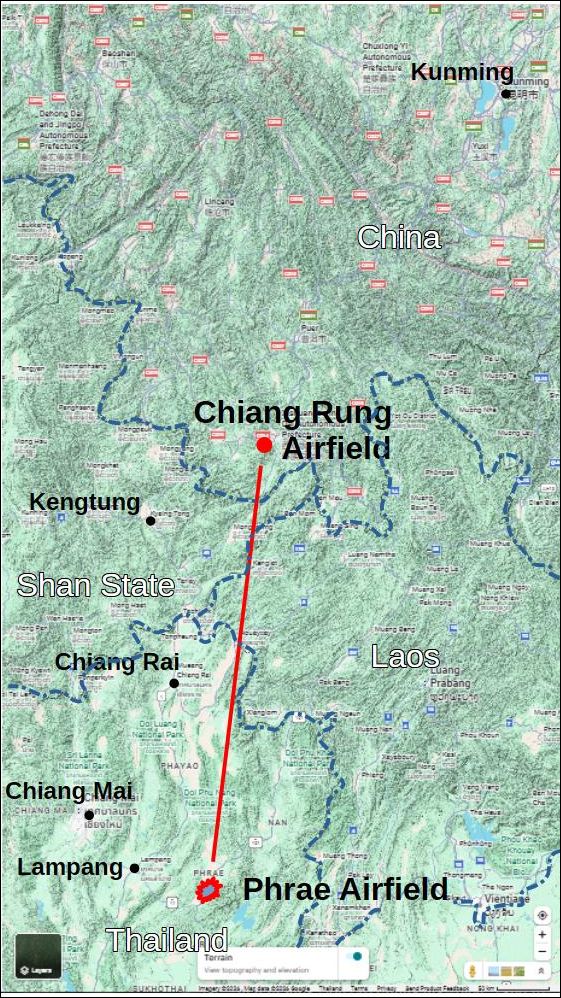 Two USAAF 449th Squadron P-38s from Chiang Rung1 (Google Maps link; aka Jinghong / Xishuangbanna) patrolling northern Thailand reported seeing five Kawasaki Ki-48 light bombers parked in five hangars and three Japanese biplane trainer aircraft at Phrae Airfield2 (Google Maps link). They strafed the aircraft, destroying the five bombers and one biplane.
References:
- ประว้ติกองท้พอากาส ในสงครามมหาเอเชียบูรพา ระหว่าง พ.ศ.-๒๔๘๔-๒๔๘๘ (นครราชสีมา: สมบูรณ์การพิมพ์, พ.ศ.๒๕๖๔) [History of the Royal Thai Air Force during the Great East Asia War, 1941-1945 (Nakhon Ratchasima: Somboon Printing, 2021)], pp 228-229 (translated):
Time 1130 hrs. Four USAAF 449th Squadron P-38 aircraft took off from Chiang Rung [aka Jinghong / Xishuangbanna, N21°58.4 E100°45.8]. Two of them had problems and had to abandon their mission; the remaining two were piloted by Maj James L Bledsoe and 1Lt Keith Mahon. Their mission was to patrol northern Thailand. Around 1300-1315 hrs, they reported seeing five Kawasaki Ki-48 light bombers parked in five hangars and three Japanese biplane trainer aircraft at Phrae Airfield. So they fired on the aircraft, destroying them all as fire engulfed the hangars.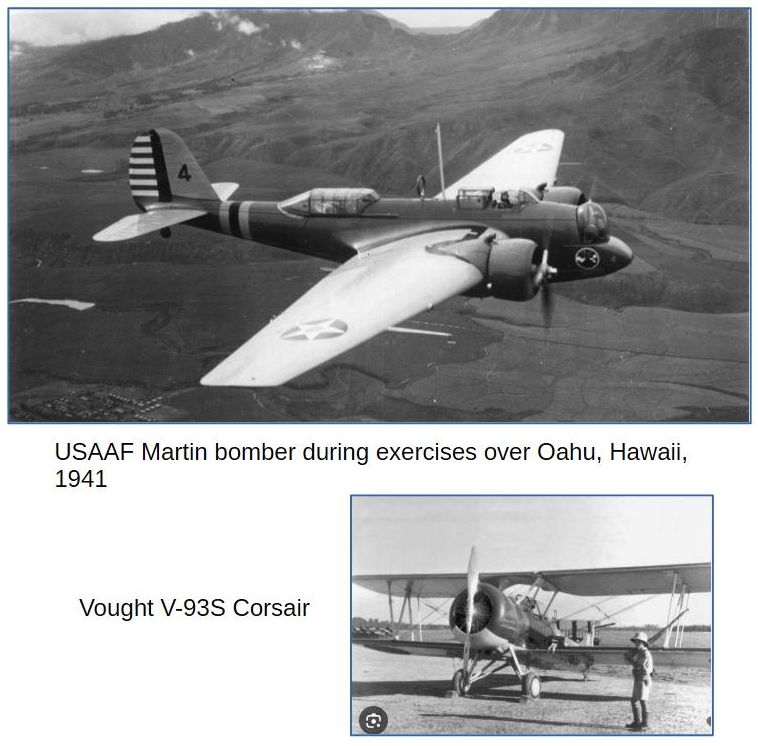 3
3
However, the planes destroyed that day at Phrae Airfield were not Japanese, but RTAF: five Martin 139WS Bombers of the RTAF 61st Squadron and a Vought Corsair, No. 5/77, of the RTAF 31st Squadron, piloted by Flt Sgt Chit Jarudecha with Sgt Put Ruayruen, a mechanic. This last mentioned plane was on its way from Nan to Koke Kathiam to receive major repairs, but had stopped at Phrae where it was caught up in the strafing, and destroyed by the patrolling P38s.
- Young, Edward, Aerial Nationalism (Washington: Smithsonian, 1995), p 203:
There were only five missions flown during September [1944], but on the last day of the month American fighters scored a particular success. Two P-38 fighters from the 449th Fighter Squadron, operating out of bases in China, discovered five twin-engined bombers at the Thai Air Force field at Phrae, southwest of Chiang Mai, which they identified as Japanese Lily bombers (the Kawasaki Ki-48 Type 99 Light Bomber), and three biplane training aircraft. The two P-38s proceeded to strafe the airfield, destroying all five bombers and the three biplanes as well as setting fire to five hangars on the airfield.
- The event is not covered in:
- K Carter and R Mueller, US Army Air Forces in World War II Combat Chronology 1941 – 1945 (Washington: Center for Air Force History, 1991)
- Eric Hammel, Air War Pacific (Pacifica Military History, 1998), Kindle edition
- Christopher Shores, Air War for Burma (London: Grub Street, 2005)
- Daniel Jackson, The Forgotten Squadron: The 449th Fighter Squadron in World War II (Atglen: Schiffer, 2010)
| First published on Internet | ||
Last Updated on 17 September 2026
- N21°58.4 E100°45.8[↩]
- N18°07.90 E100°9.90[↩]
- Photos: a Martin B-10 variant (offsite link) of the 23rd Bombardment Squadron during exercises over Oahu, Hawaii, 1941; Harold Wahlberg – Self-photographed.
Vought V-93S Corsair, Aircraft of the Royal Thai Air Force (offsite link).[↩]