A Draft of Cherdchai’s Missing Allied Pilot
The following is a translation of a draft in Thai of a review of some events revolving around the air crash of 1Lt Theodore H Demezas, a USAAF pilot, in Lampang on 12 July 1945. It begins with an interview by Cherdchai Chomtawat with Maytah Gietpong dated 14 March 2008 (this was shortly before Jack Eisner’s interview with Maytah on 18 October 2008). Maytah witnessed the capture of 1Lt Demezas after he parachuted from his P-38 fighter following damage by groundfire over Lampang on 12 July 1945. Cherdchai’s draft follows that interview with three short biographies:
- Maytah Gietpong (the interviewee)
- The Royal Thai Army officer Sarit Thanarat who took custody of Demezas
- Prince Khun Sak-Mengrai (aka Sao Khun Sak Mengrai) who served as British Consul in Chiang Mai after the war.
Cherdchai provided the draft to Jack Eisner1 who in turn had it translated by Ben Barraclough.2 Comments in addition to those of the translator are enclosed in brackets or entered as footnotes.
Missing Allied Pilot
by Cherdchai Chomtawat
[Translation by Ben Barraclough]
Translator’s Remarks
This article appears to be a preliminary draft, since there are numerous handwritten corrections, spelling mistakes, errors in fact, and multiple instances of repetition. [A final version, if published, has not been found.]
Article
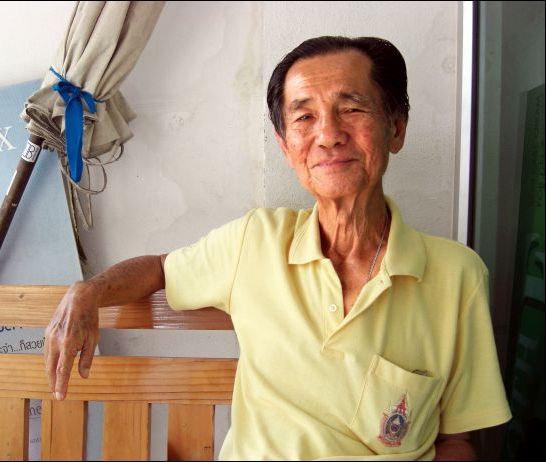 Mr Maytah Gietpong,3 aged 81, currently living at 90/116 Moo 5, Tambon Suthep,4 (Google Maps link) Amphoe Muang, Chiang Mai Province, is originally from Lampang province. In his youth, he studied at Kenneth MacKenzie School,5 (Google Maps link) a school for foreigners in Lampang. During WWII when Maytah was 15 – 16 years old and studying in M 5 (11th Grade), the school was closed, and students had to study at Bunyawat school6 [Google Maps link: Bunyawat Witthayalai] instead. Not long after that, Bunyawat school was transformed into a military camp and students once again had to move, this time to Wat Phra Kaew7 (Google Maps link) in Tambon Wiang Nuea for their studies.
One afternoon around 1300 hrs, while Maytah and his friends were on their way to play in the Wang River, they heard the sound of an airplane over Lampang city and saw the pilot bail out from an aircraft at high altitude. After deploying his parachute, the pilot was gradually blown west over Kenneth MacKenzie School towards Tambon Thalor.8 Maytah and his friends, as well as a few other onlookers, followed the parachute on foot. At first, they assumed the pilot would land close to where he bailed out from the aircraft, but as they kept running after him, looking up as they went, he showed no sign of landing anytime soon. Eventually, after running for 3–4 kilometres, they finally saw the pilot touch ground in a Jujube forest,9 where it appeared he was attempting to hide. Apart from the children, a gathering crowd of around 100 people included villagers as well as Thai and Japanese soldiers.
Since Maytah had studied English at MacKenzie, a foreign school, he began calling into the forest for the pilot to come out, shouting “Come here, come here” until the pilot finally emerged. He headed towards the Thai side of the crowd, which included Thai soldiers led by Lt Col Sarit Thanarat10 (later a Prime Minister (offsite link) ). Japanese soldiers said they were the ones who shot down his aircraft, therefore they should take custody of the pilot. The Thai soldiers weren’t willing to admit that the Japanese had shot down the aircraft, which led to an argument. The Japanese started by asking from which direction the Thais were firing in and how many rounds had been fired. When the Thais replied that they fired until they ran out of ammunition, the Japanese soldiers weren’t willing to give up and asked to take the pilot for interrogation. As the two sides kept on arguing, Lt Col Sarit took advantage of the chaos and quickly bundled the pilot into a black Austin saloon and drove off, leaving the confused Japanese soldiers speechless.11
Maytah said the foreign pilot looked quite young and must have been around 18 years old. He had red hair, was around 170 cm tall, and was wearing a greyish pilot uniform, but he did not know what rank he was. He was quite astounded that such a young man had the ability to fly an aircraft, let alone drop bombs. He found out later that the aircraft crashed about two or three kilometres from where they saw the pilot bail out, but he never went to look at the wreckage himself. [this location doesn’t necessarily contradict 1Lt Stanton’s observation that Demezas hit ground about 35 yards from the actual crash site since Demezas was described by Maytah as having drifted quite a distance after bailing out. And, at that point, their attention had been riveted on the pilot, not the crash site.]
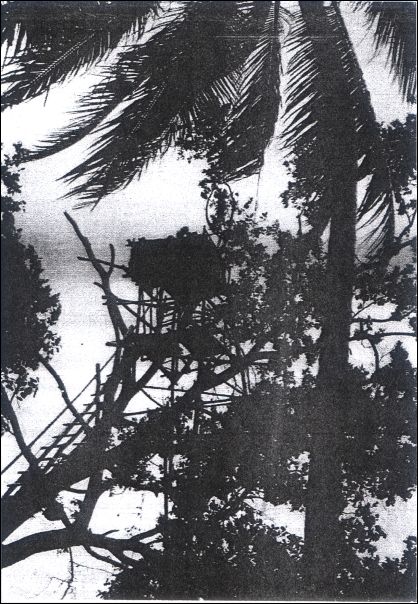
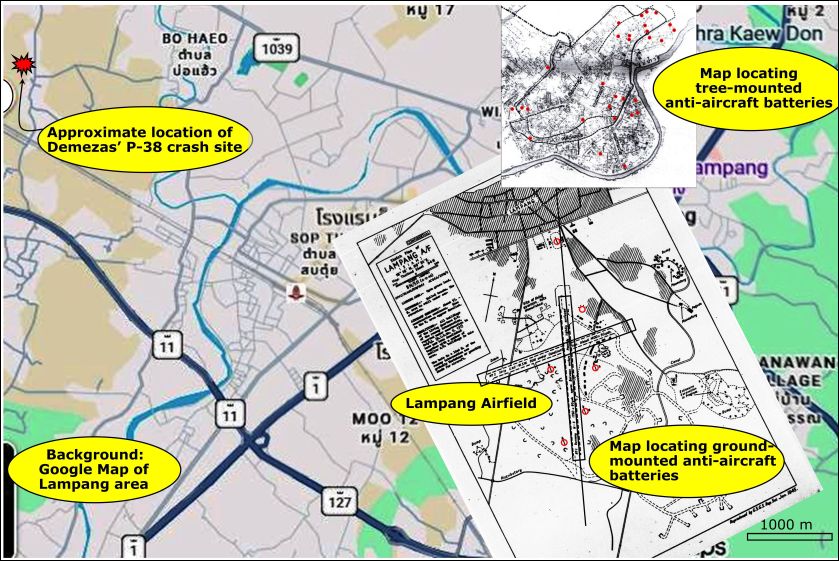
Eyewitness accounts would later say that on the day of the incident two “twin-boom” aircraft (some identified them as Allied Lockheed P-38s) attacked Lampang (Phrabat) Airfield, where Japanese forces were garrisoning their planes. On their third attack run,12 Japanese forces fired on the two aircraft, using small anti-aircraft (AA) batteries mounted in treetops to provide a good vantage point on the south side of the airfield.13
Typical treetop AA installation:14
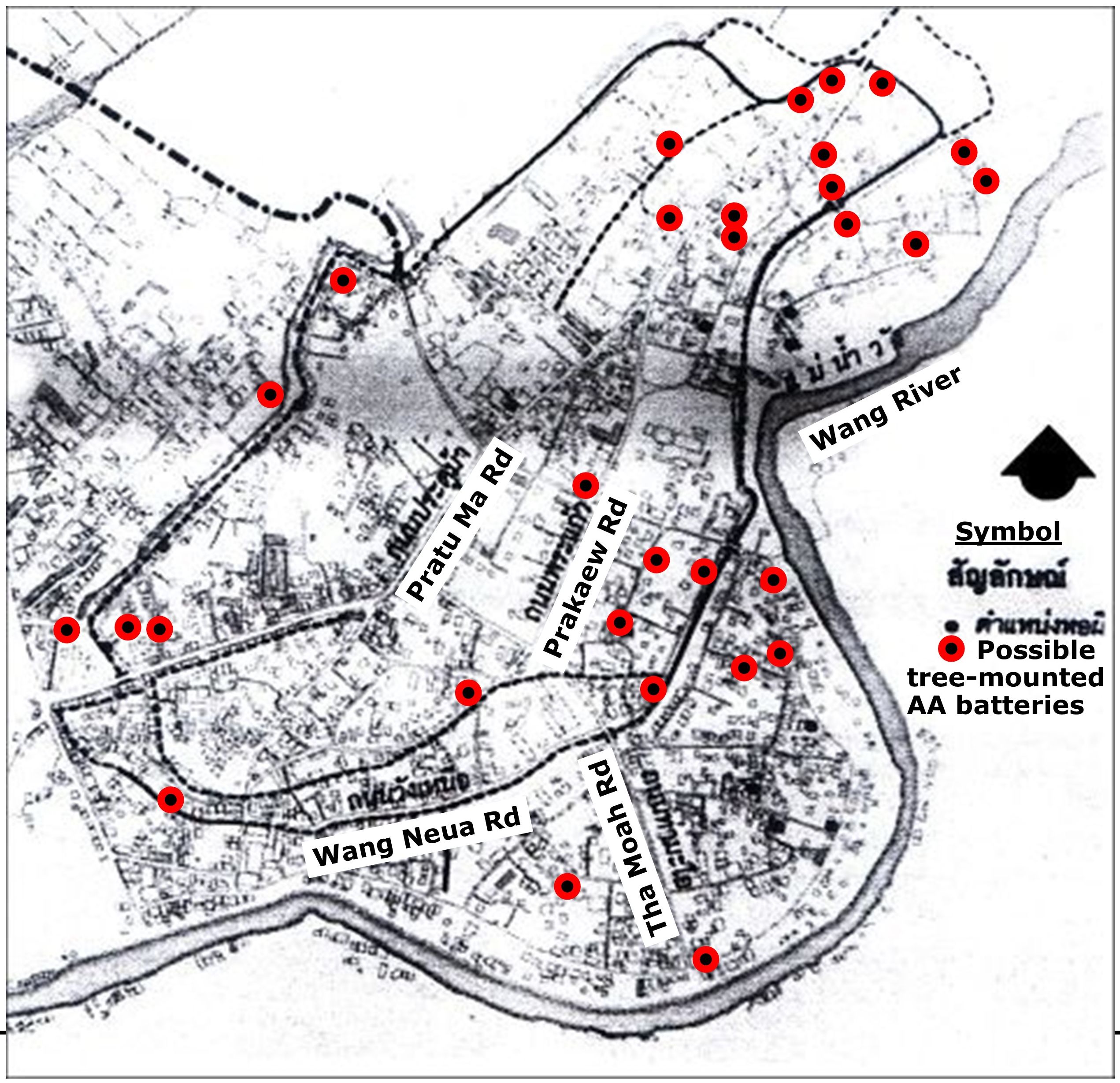
MAP LOCATING TREE-MOUNTED ANTI-AIRCRAFT BATTERIES
A map was included in Cherdchai’s package to Eisner about Demezas; but its source and accuracy are unknown. English language items are per Ben Barraclough15
This map, when melded with Allied sketches of the airfield, was used to place all known AA implacements protecting the airfield superimposed on a present day Google Map of the area:16
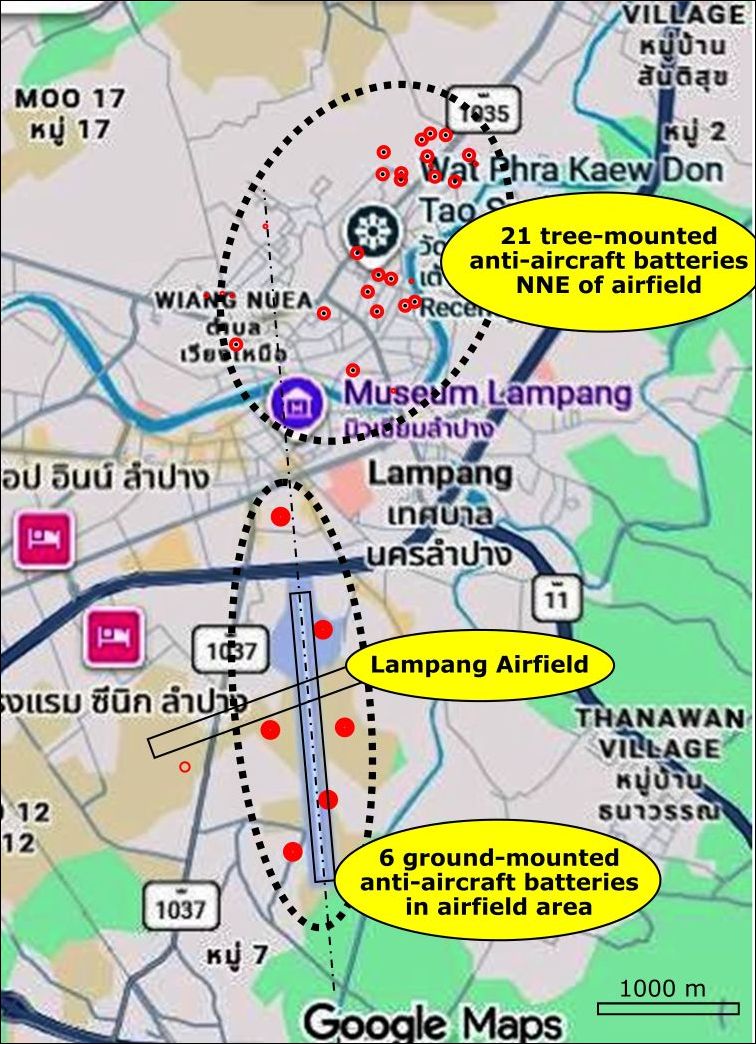
One aircraft was shot down as described previously, while the other flew off and disappeared.
This airfield was often attacked by Allied aircraft which would fly at treetop level to avoid being targeted by large AA batteries installed by the Japanese further north next to Bunyawat school. This led Japanese forces to use the strategy described above [But again note the confusion here: the detailed map of AA implacements are to the north of airfield, but are labeled treetop installations].
It would later be learned that, after Lt Col Sarit had snatched the pilot, he took him into Lampang where he handed him over to the Free Thai Movement. The leader of the movement in Lampang was Mr Wichai Lojaya, whose cover in those days was working in a sugar factory (the Ko Kha Sugar Factory). Knowledgeable sources said Field Marshal Sarit was a [risk taker?], capable of making quick decisions, who would often refuse to comply with Japanese soldiers’ wishes. After the incident, the story of the event quickly faded. Even today, no one really knows who the pilot was or to which unit he was attached. Even the wreckage of the aircraft disappeared without a trace. Some people call the operation on that day “Operation Allied Pilot Kidnapping”. When Japanese soldiers questioned Lt Col Sarit, his responses ranged from “It’s the Thai Military’s business”, “The pilot is in a safe location”, “He was passed onto the Northern Unit for processing”, “I don’t know where he is”, etc.
Maytah’s mother, named Yai, had a grocery shop called “Sakunchai Shop” on the fresh market street/road.17 Since her shop offered more products than others, Japanese Commissariat/Quartermasters came to buy produce daily. Maytah’s mother would often ask the Japanese forces what they required and would order all the extra products they requested. Rumours said she made a lot of money from doing so. The rice she initially sold was already of high quality, but when Japanese soldiers complained they didn’t like it because it wasn’t sticky enough and showed her examples of Japanese rice, she told them it would be an easy fix. Afterwards, she began experimenting with mixing high quality sticky rice with rice from central Thailand in a ratio of 1:1. Each sack of rice she bought was 80 baht. Maytah had the task of mixing the two types of rice together and packaging them in new sacks of 100 kg each. They then sold those to the Japanese army for 400 baht each, giving them immense profits. Apart from rice, they also ordered many extra products and foodstuffs, so much so that word made it to Lt Col Sarit, who was keeping tabs on the Japanese army.
Sarit Thanarat
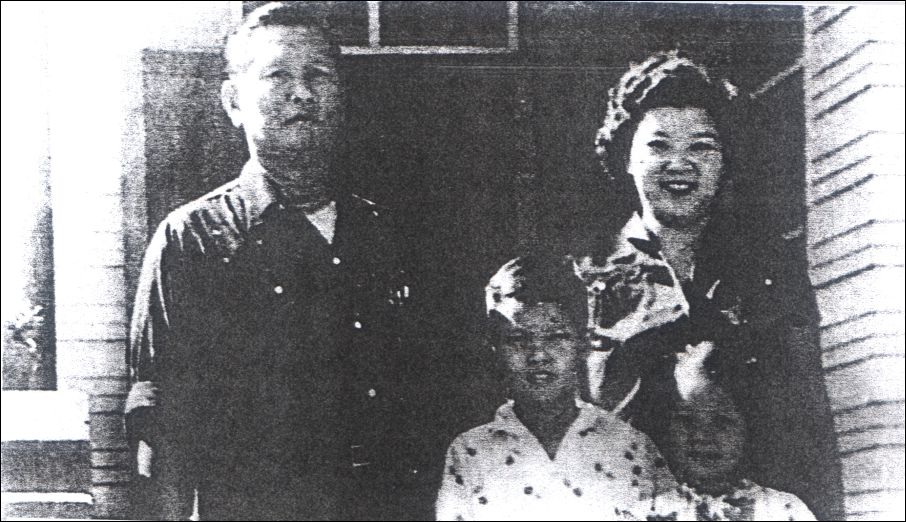 Sarit Thanarat, with family; photo from draft. 18
Sarit then began frequenting the shop and befriended the family, and soon began dropping by in the late morning on most days to ask Maytah what the Japanese were purchasing from them. Excited that a high-ranking military officer was so friendly with him and often came over to chat, Maytah would always quickly report all the day’s happenings to him. Wherever they met, Sarit would call Maytah “Ai Tee” every time, giving him the impression that they were close friends. Later19 after the war had ended, Sarit told Maytah’s mother that when he was in Lampang he had been given eight pay raises. He told her that normally this type of raise was reserved for soldiers who died in the line of duty only, and he didn’t know how he got so lucky as to receive it. If he hadn’t been stationed in Lampang, he thought he probably would not have received such generous treatment.
Sarit had been stationed in Lampang possibly as a reserve officer in the Army on 05 November 1943 with the rank of Major. Later, he was promoted to Lieutenant Colonel on 01 September 1944 and given the position of Commander of the 18th Infantry Regiment of Lampang. Once the war was over, he was promoted once again to Colonel on 01 July 1946 and given the position of Commander of the 1st Infantry Regiment, King’s Close Bodyguard. It’s interesting to note that between 1943 and 1946 while Field Marshal Sarit was stationed in Lampang, he was promoted from Major to Colonel which meant, in total, eight pay raises within a period of only two years and two months. One explanation for this, other than his personal abilities, could have been because Lampang was an important strategic location where forces and equipment from many sides gathered. These included the Northwestern Thai Army, Japanese forces, both infantry and air force, who were cooperating with the Thai forces as per a Thai–Japanese agreement, hundreds of Japanese aircraft, and movements of Burmese Independent Forces within the city. Lampang at the time also happened to be a centre for multiple airlines flying in the region, for example the Lampang – Taungoo – Yangon route. A large quantity of western companies’ assets also passed through the region. There were also spies from the Thai underground secretly present as well. All in all, there were Western, Japanese, Burmese, and Thai forces operating in Lampang at the same time, each of them keeping an eye on each other’s movements, mixed in with trade in various different currencies, and a counterfeit money crisis. People were smoking opium freely, and gambling, prostitution, and entertainment venues were abundant, making large amounts of money for owners of those establishments. Additionally, a new type of job evolved – watching over or controlling businesses and their assets by hooligans. This was why Lampang was called by some in those days, in translation, the Yaowarat or Golden City of the North or ‘Eldorado’. When compared to Chiang Mai at that time, Lampang was the more developed and bustling city while Chiang Mai was peaceful and quiet, the opposite of how it is today.
Keeping law and order in the country, which was under martial law during the war, was hard work for soldiers and government officials. Sarit, who was overseeing the situation in Lampang, shared that effort. The biggest issue facing him during that time was finding a way for Japanese troops and Thai citizens to coexist peacefully. In the end, there were no violent disagreements between the two groups within the province, which was likely another reason why he received his eight raises.
Retired Japanese troops often said those stationed in Lampang were more comfortable and better off than those stationed elsewhere. Cooperation between the two sides was also very good, as shown during the seizure and occupation of Kengtung, a city in the Shan State, taken from Burma by the Thai Army with the aid of Japanese forces.
Prince Khun Sak-Mengrai
After the war ended in 1945, a new problem arose when Kuomintang forces were adamant about helping disarm Japanese forces in Thailand, so much so that they began preparing to cross the Thai border. The Thai army knew that if they complied with the Kuomintang, northern Thailand would soon be overflowing with Chinese; so they turned to the Allies for aid in disarming the Japanese forces instead. A group was assembled of a few British soldiers supervising a number of Gurkhas for the task. After the disarmament process was completed in 1946, most of the Allied troops were recalled, leaving a small but unknown number of Gurkhas behind to help the British Consulate in Chiang Mai: they were tasked with watching over the entire northern region. Prince Khun Sak-Mengrai20 who then held the rank of major, was appointed British Consul in Chiang Mai following the war (succeeding the first British consul, WAR Wood, who had been appointed in 1921 and interned during the war) and ambassador/emissary((Translator’s note: from extra research (though unconfirmed sources), he seems to have been appointed a military ambassador] of the British 207 Military Mission. Prince Khun Sak-Mengrai always had a good relationship with Sarit. After the war they peacefully cooperated in disarming Japanese forces in Burma and northern Thailand.
[The rest of the draft is omitted because of:- Inaccurate technical information about Allied P-38 fighter aircraft.
- Earlier assumptions used to incorrectly identify the crash.
- Disorganized presentation about tactics used by Allied aircraft in attacking ground targets and by Japanese / Thai use of anti-aircraft guns in defending against those attacks.]
[signed] Police Major Cherdchai Chomtawat
17/03/08
(Continued: The Draft in Thai of Cherdchai’s Missing Allied Pilot)
Last Updated on 7 September 2026
- and Jack to me via his emails 1131 and 1143 05 Jan 2021[↩]
- provided by email 0718, 28 Jan 2021; my ref for translation: \02500 Tango\_Crash sites N TH for Tango\DETAIL SHEETS\A450712 Demezas [A12]\Cherdchai doc via Jack\Jack xlatn[↩]
- Photo by Jack Eisner, 2008; my ref: \02500 Tango\Crash sites N TH for Tango\DETAIL SHEETS\A450712 Demezas [A12]\Cherdchai doc via Jack\Thai info ORIGINAL\11a Mengrai cut.jpg[↩]
- N18°47.46 E98°57.64[↩]
- N18°18.03 E99°29.15[↩]
- N18°17.22 E99°30.13[↩]
- N18°18.07 E99°30.55[↩]
- N18°19.10 E99°27.62; the reference to Tambon Thalor / Tha Lo is somewhat confusing: a village of that name is about 3 km WNW of MacKenzie School on present day Highway 1039 (there was a tambon with that name in Amphoe Lampang Mueang at that time, presumably in the same general area). It is assumed that the highway was followed by Mayta in getting to Demezas. Mayta described Demezas’s landing point as between Mayta’s original observation point, which is not clear, and the actual crash site, which has subsequently been located. Where Demezas touched ground is not clear.[↩]
- Curious: Jujube trees are noted for their thorns. It might have been a painful landing.[↩]
- Translator notes that the Thai surname was spelt incorrectly in the article[↩]
- Cherdchai explained later that the reason the Allied pilot was smuggled away by Field Marshal Sarit on that day was to avoid a potential conflict in the future between Japanese and Allied forces.[↩]
- The missing aircrew report (MACR) recorded that the two aircraft had only been reconnoitering, not attacking.[↩]
- It’s not clear if the text locating the treetop AA guns is in error in placing them south of the airfield, for the map accompanying the article shows a large number of such AA guns north of the airfield. The statement of Lt Stanton, Demezas flight companion, doesn’t give sufficient detail to clarify that ambiguity. Stanton lost sight of Demezas while they were circling the Lampang airfield. He next saw Demezas, after his plane was damaged, heading “on course for home”, which would have been northward. Demezas and aircraft both hit ground to the northwest of Lampang airfield.[↩]
- article p 7; my ref: \02500 Tango\_Crash sites N TH for Tango\DETAIL SHEETS\A450712 Demezas [A12]\Cherdchai doc via Jack\Thai info ORIGINAL\07 tree.jpg[↩]
- Barraclough cautions that the locations shown on the map are ambiguously titled (in Thai) “ghost towers” and he suggests that they may be the tree-mounted AA units; however, there doesn’t seem to be an alternative explanation. Original report map, annotated by author using Microsoft Publisher; my ref: \02500 Tango\_Crash sites N TH for Tango\DETAIL SHEETS\A450712 Demezas [A12] (1)\Cherdchai doc via Jack\Jack xlatn\AA locatns.jpg[↩]
- My ref: \02500 Tango\_Crash sites N TH for Tango\DETAIL SHEETS\A450712 Demezas [A12] (1)\Cherdchai doc via Jack\Jack xlatn\Lpg AA locatns.jpg. Map is extracted from this composite:
- Cherdchai’s map of tree-mounted AA batteries (see above for detail)
- Airfield Report No. 30, Jan 1945, of Lampang Airfield, unnumbered page (USAF Archive microfilm reel A8055 p 1202)
- Google Map view of Lampang airport area. My ref: \02500 Tango\_Crash sites N TH for Tango\DETAIL SHEETS\A450712 Demezas [A12] (1)\Cherdchai doc via Jack\Jack xlatn\Map GM composite.jpg
 [↩]
[↩] - either the name of a road, or a road by a fresh market[↩]
- my ref: \02500 Tango\_Crash sites N TH for Tango\DETAIL SHEETS\A450712 Demezas [A12] \Cherdchai doc via Jack\Thai info ORIGINAL\Demezas P38 crash Lampang 12July1945 (Thai text) p6-extr.jpg[↩]
- As possibly recorded in military camp records?[↩]
- Per a Google search by Jack Eisner (per his email of 1829, 05 Apr 2026): Prince Khun Sak-Mengrai (also known as Sao Khun Sak Mengrai or Chao Khun Suek Mengrai, and note that the translator used “Prince Koonsuk-Mengrai”) was a Shan prince from the Kengtung ruling family who served as a major in the British Army during World War II and subsequently led the 207 Military Mission in Southeast Asia.
Background and Military Service
-
- Heritage: He was the son of Sao Kawn Kiao Intaleng, the ruler of Kengtung (Southern Shan State).
- Education: He was educated in Burma at the Government English High School in Maymyo and the Government High School for the Sons of Chiefs in Taunggyi, later attending university in Rangoon.
- WWII: During World War II, he was mobilized into the British Army’s Burma Rifles, rising to the rank of Major, and served with the 1st Burma Brigade, the 81st West African Division, and the General Staff in Calcutta.
207 Military Mission
-
- Role: Following the war, he served as a key official for the British 207 Military Mission, which was part of the South East Asia Command (SEAC).
- Mission Goal: His primary task in 1946 was to lead in the disarmament of Japanese forces in Northern Thailand following the surrender.
- Activities: Records indicate he was heavily involved in post-war reorganization in the region, with documentation mentioning his role in handling Japanese soldiers and associated logistical issues.
Post-War Life
-
- British Consul: After the war, he served as British Consul in Chiang Mai, Thailand, reopening the consulate after it had been closed during the war.
- Family: He married Mom Thada (née Thada Pattanathabut) and his descendants form the Khun Sak-Mengrai family.
The Prince is remembered as a significant figure bridging the British military administration and the local Shan / Northern Thai nobility during the transition from Japanese occupation.[↩]
-